Turkish Baklava Pastry: A B2B Wholesale Sourcing Guide for European Buyers
Turkish baklava pastry is not a generic product. It is the result of a specific ingredient ecosystem, a production culture that spans centuries, and a geographic tradition concentrated in a single city — Gaziantep — whose name has become synonymous with the highest quality expression of the product. For European B2B buyers evaluating their baklava sourcing, understanding what makes Turkish baklava pastry distinct — and what separates authentic production from the commodity alternatives that fill much of the European market — is the foundation of a sourcing decision that will perform over time.
This guide is written for retailers, foodservice distributors, importers, and private label brands who are sourcing Turkish baklava pastry for the European market, or who are reviewing an existing supply relationship and want to understand whether they are accessing the quality that the category’s best production genuinely offers. It covers what Turkish baklava pastry actually is, what its defining ingredients are, which formats are commercially relevant for different buyer segments, and how to find and qualify a supplier who can deliver authentic Turkish baklava pastry at wholesale scale.
The commercial opportunity in Turkish baklava pastry across European markets is real and growing. The buyers who capture it most effectively are those who source from the right origin, with the right production standard, from a supplier whose capability matches their commercial requirements.
What Turkish Baklava Pastry Actually Is — and What Makes It Different
Turkish baklava pastry is a layered pastry dessert built from hauchdünner filo dough, a nut filling — most authentically the Antep pistachio — pure butter applied between each layer, and a sugar syrup applied after baking. In this description it sounds simple. In execution, particularly at the scale required for serious wholesale supply, it is one of the most technically demanding pastry products in any commercial food category.
What makes Turkish baklava pastry specifically Turkish — and specifically valuable as a commercial product — is not merely its geographic origin but what that origin delivers in terms of ingredients and production expertise. The Antep pistachio, grown in the agricultural region around Gaziantep, is available nowhere else in the form that defines the product. The production knowledge concentrated in Gaziantep — how to roll filo to the correct thickness, how to layer it with butter at the right temperature, how to calibrate the syrup application so that the pastry is moist without becoming soggy — is embedded in a manufacturing culture that has no equivalent outside the city.
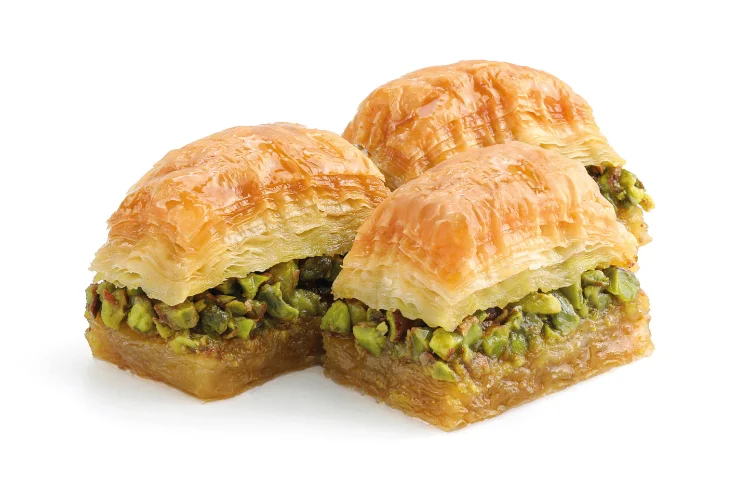
The difference between authentic Turkish baklava pastry produced in Gaziantep and generic baklava produced in a European food manufacturing facility using substitute ingredients is immediately apparent to any consumer who has eaten the real product. The colour of the pistachio filling — a vivid, deep green that Antep pistachios produce and no substitute variety replicates. The flavour intensity of the nut filling — rich, complex, dominant over the sweetness rather than buried by it. The texture of the filo — thin, consistent, creating a crunch that compressed commodity filo cannot match. These are not subtle differences. They are the differences that determine whether a consumer makes a repeat purchase or not.
For B2B buyers, this quality difference translates directly into commercial performance. Turkish baklava pastry from a genuine Gaziantep producer holds its value on the retail shelf, satisfies the quality expectations of Middle Eastern restaurant buyers, and supports the premium price positioning that makes the category commercially interesting. Generic baklava from a non-specialist producer does not.
The Ingredients That Define Authentic Turkish Baklava Pastry
The quality of Turkish baklava pastry is determined by four ingredients, each of which has a quality ceiling defined by its source and a quality floor below which the product fails to be what it claims to be.
The Antep pistachio is the defining ingredient of authentic Turkish baklava pastry. Grown in the agricultural region surrounding Gaziantep, the Antep pistachio is smaller than Iranian or Californian varieties, more intensely flavoured, and naturally vivid green — a colour that comes from the specific combination of soil, climate, and growing conditions in the Gaziantep region and cannot be replicated by growing the same variety elsewhere. A Turkish baklava pastry producer based in Gaziantep sources Antep pistachios directly from local growers, at optimal freshness, through supply relationships that have often been maintained for generations. The product that results is measurably different — in flavour, in colour, in eating quality — from Turkish baklava pastry made with substitute pistachio varieties sourced from outside the region.
The nut content percentage per piece is the quality variable that most directly translates ingredient cost into product quality. A Turkish baklava pastry with inadequate pistachio filling is immediately recognisable — the eating experience is dominated by sweetness and pastry rather than by the rich, complex flavour of the nut. Buyers evaluating Turkish baklava pastry suppliers should ask explicitly for the nut content specification per piece and confirm how it is enforced across production runs.
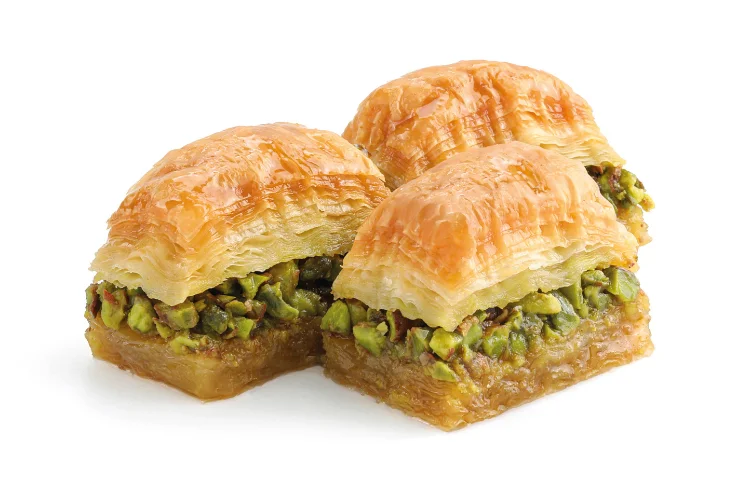
Filo pastry is the second defining ingredient of Turkish baklava pastry quality. Authentic Gaziantep production uses filo rolled to a consistent thickness — thin enough to create the characteristic layered crunch, consistent enough that every piece in a production run has the same texture. At the scale required for wholesale supply, this requires either in-house filo production with tight process controls or sourcing from a specialist filo producer with an equally tight specification. Turkish baklava pastry from a producer who buys commodity filo from a generic pastry supplier is working with a lower-quality input that compromises the texture of the finished product.
Real butter is the third defining ingredient. Authentic Turkish baklava pastry uses pure butter — typically clarified — applied between each filo layer. Producers who substitute vegetable fat for butter reduce their input cost significantly, but produce a product with a fundamentally different flavour profile. The rich, dairy-forward character of well-made Turkish baklava pastry comes from real butter. Vegetable fat substitutes produce a product that is flatter in flavour and greasier in texture — differences that are immediately perceptible to any consumer familiar with the authentic product.
Sugar syrup is the finishing ingredient that binds and sweetens Turkish baklava pastry after baking. The syrup formulation — sugar concentration, temperature of application, volume per piece — determines the moisture balance of the finished product. Too much syrup produces a soggy product. Too little produces a product that is dry and crumbles prematurely. The syrup application in authentic Turkish baklava pastry is calibrated so precisely that the product is moist, sweet, and structurally intact — qualities that must be maintained consistently across thousands of pieces per production run.
Turkish Baklava Pastry Formats: What European Buyers Should Know
Turkish baklava pastry is not a single product — it is a product family that encompasses several distinct formats, each with different commercial applications and different production requirements. European B2B buyers who understand the full format range make better ranging decisions and qualify suppliers more effectively.
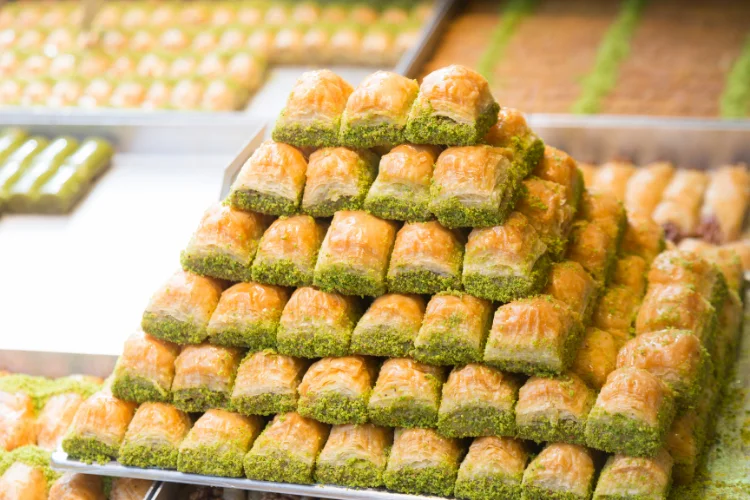
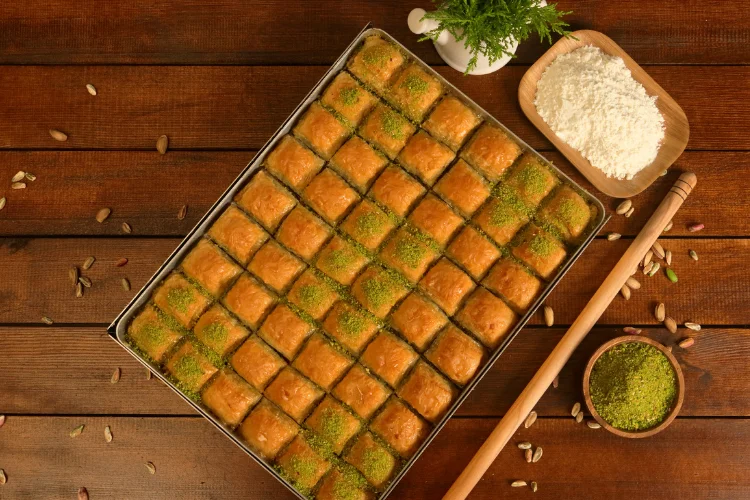
The classic rectangular cut — sometimes called the Gaziantep cut — produces long, flat pieces with a high surface-area-to-depth ratio that emphasises the layered filo structure. This is the format most closely associated with authentic Gaziantep production and the one that most clearly communicates the pastry craftsmanship involved. The diamond cut produces the more widely recognised rhombus shape, with a slightly thicker profile that travels well in retail packaging. Both are core Turkish baklava pastry formats for retail and foodservice supply.
Rolled Turkish baklava pastry formats — finger baklava and cigar baklava — use filo sheets rolled around a nut filling rather than layered. The result is a cylindrical format with a different visual presentation and a more compact eating experience. Rolled formats perform well as individual portion products in foodservice and as premium line extensions in retail ranges.
Specialty formats expand the Turkish baklava pastry range beyond the classic filo-based products. Bird’s nest — small round nests of filo or kataifi dough filled with pistachios — is the most visually distinctive Turkish baklava pastry format and performs exceptionally well in premium retail gifting and plated dessert applications. Kadaifi — made from shredded wheat strands rather than filo sheets — is one of the most commercially underranged formats in European markets relative to its consumer demand potential. Künefe — shredded wheat pastry with fresh cheese, served warm — sits alongside classic Turkish baklava pastry in Anatolian dessert tradition and has a growing following in European foodservice.
Assorted gift tray formats — combining multiple Turkish baklava pastry types in a single presentation — are the highest-performing commercial format for retail gifting occasions. Ramadan, Christmas, Eid, and corporate gifting windows all represent significant assorted tray sales opportunities that reward buyers who have ranged the full product breadth.
Why Turkish Baklava Pastry Outperforms Alternatives in European Markets
The European baklava market contains product from several distinct traditions — Turkish, Greek, Lebanese, and European-produced — and B2B buyers who understand the commercial differences between them make better sourcing and ranging decisions.
Greek baklava uses honey syrup rather than sugar syrup, and typically uses walnuts rather than pistachios as the primary nut. The result is a product with a distinctly different flavour profile — sweeter, heavier, with the distinctive floral note of honey rather than the clean sweetness of sugar syrup. Greek baklava has its own loyal consumer segment, but it is a different product from Turkish baklava pastry and should be evaluated as such rather than as a substitute.
Lebanese baklawa uses rose water or orange blossom syrup and typically features smaller, more varied formats with a lighter texture. It serves the Arabic-heritage consumer segment with different expectations from those of Turkish baklava pastry consumers. Again, a distinct product rather than a substitute.
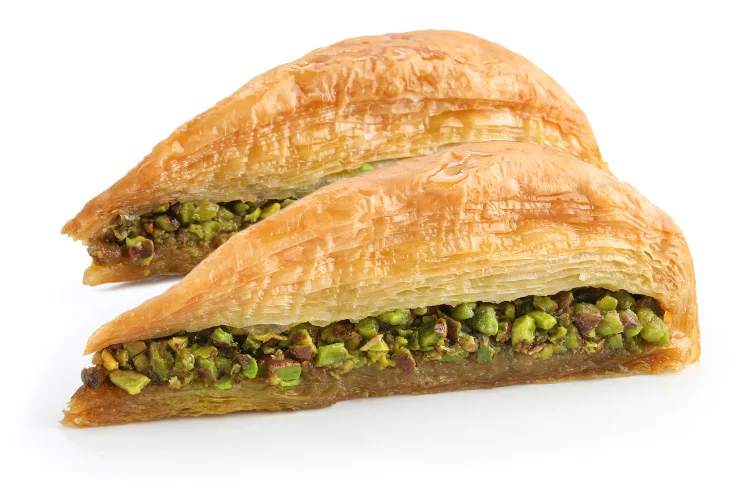
European-produced baklava — manufactured in France, Germany, the Netherlands, or the UK using locally sourced or imported ingredients — attempts to replicate Turkish baklava pastry outside the ingredient ecosystem that defines its quality. The results are consistently inferior to Gaziantep-origin Turkish baklava pastry: substitute pistachio varieties that lack the colour and flavour intensity of Antep pistachios, vegetable fat in place of butter, and commodity filo that lacks the consistency of specialist Gaziantep production. European-produced baklava competes on price and logistics convenience. It does not compete on quality.
For European B2B buyers, the commercial implication is clear. Turkish baklava pastry from a Gaziantep producer is the format that performs at premium price points, satisfies the quality expectations of Turkish and Arabic diaspora consumers, and supports the clean label and provenance positioning that premium retail and quality foodservice requires. It is the quality ceiling of the category — and buyers who source from that ceiling build ranges that hold their commercial value over time.
Frozen Turkish Baklava Pastry: Why It Is the Right Format for Wholesale
The decision a Turkish baklava pastry producer makes about shelf life extension — freeze the product or add preservatives — is one of the most commercially significant quality signals a B2B buyer can read.
Preservative-stabilised ambient Turkish baklava pastry is simpler to distribute and requires no cold chain management. It is also a compromised product. Preservatives alter the flavour profile of Turkish baklava pastry in ways that are immediately perceptible to consumers familiar with the authentic product — the characteristic freshness of filo, the intensity of the pistachio filling, and the clean sweetness of the sugar syrup are all affected by preservative chemistry. A preservative declaration on the ingredient list also forecloses clean label positioning and premium retail placement.
Frozen Turkish baklava pastry achieves shelf life without compromising the recipe. A producer who freezes at the point of production — before any quality degradation has occurred — delivers to a European distribution point a product that thaws to the eating quality of freshly made Gaziantep baklava. The filo retains its texture. The pistachio filling retains its flavour. The syrup balance is what the recipe specifies, not what preservative stabilisation requires.
The cold chain requirements for frozen Turkish baklava pastry wholesale are standard for the frozen food category: -18°C maintained from production through transit and storage, with temperature monitoring documentation accompanying every shipment. From Gaziantep to Northern European distribution points, frozen container shipment via the Turkish port system operates on reliable schedules with documented cold chain integrity.
For retail buyers, frozen Turkish baklava pastry supports clean label positioning — no preservatives, no artificial additives — that is commercially valuable in premium grocery. For foodservice buyers, it delivers the portion consistency and operational reliability that professional kitchen environments require. For private label buyers, it provides the recipe integrity that a branded product range depends on.
What European B2B Buyers Should Look for When Sourcing Turkish Baklava Pastry
The qualification framework for Turkish baklava pastry sourcing covers several areas that must be assessed independently — a strong score in one area does not compensate for a significant weakness in another.
Production origin is the first and most important criterion. Authentic Turkish baklava pastry is produced in Gaziantep — the only location that combines Antep pistachio access, generational production expertise, and a manufacturing culture that has developed the quality management systems for consistent large-scale production. A supplier claiming to produce authentic Turkish baklava pastry outside Gaziantep is either sourcing ingredients from Gaziantep at a disadvantage or producing a product that falls short of the Gaziantep quality standard.
Certifications are the second criterion. BRCGS, IFS Food, and FSSC 22000 are the food safety certifications that distinguish serious Turkish baklava pastry suppliers from the broader market. HACCP is the legal baseline. Halal certification must cover the full product range and must be current and from a recognised body. Buyers should request actual certificates and verify scope — not accept verbal confirmation.
Product range depth reveals the genuine scope of a supplier’s Turkish baklava pastry capability. A supplier who produces pistachio and walnut baklava at consistent quality, but whose kadaifi and künefe products are clearly produced as afterthoughts, is not a full-range Turkish baklava pastry supplier. Request samples across the full intended range before committing.

Private label capability should be assessed at the qualification stage even if there are no immediate private label plans. Turkish baklava pastry suppliers with genuine private label programmes — currently producing for multiple brands across multiple markets — have the organisational infrastructure to support private label development when a buyer is ready for it.
Logistics and lead times must be realistic for the buyer’s inventory management requirements. Turkish baklava pastry from Gaziantep typically involves three to five weeks lead time from order confirmation to European delivery — forward ordering on a schedule that accounts for this lead time is the correct operational approach.
Turkish Baklava Pastry for Retail: Building a Range That Performs
A retail Turkish baklava pastry range is built around three commercial tiers that together serve the full spectrum of the category’s consumer demand.
The core volume tier anchors the range with walnut and pistachio Turkish baklava pastry in standard cuts — accessible price points that drive repeat purchase and category footfall. These products move consistently year-round and form the sales foundation that justifies the shelf space investment.
The mid-range tier adds format variety: cashew baklava, mixed nut formats, kadaifi, and rolled formats for buyers whose customer base has familiarity with the broader Anatolian pastry tradition. These products increase basket size for engaged category buyers and signal a serious category commitment.
The premium and gifting tier brings in bird’s nest formats, specialty cuts, and assorted gift box Turkish baklava pastry — products that perform in gifting windows and carry the highest unit margins in the category. Ramadan, Christmas, and Eid are the three most commercially significant windows for premium Turkish baklava pastry gifting in European retail.
The retail viability of Turkish baklava pastry at all three tiers is demonstrated by the category’s performance in major European retail chains. Partnerships between serious Gaziantep producers and leading retail chains — including Aldi and Kaufland in the German and European market — confirm that authentic Turkish baklava pastry performs at retail scale across both value and mainstream positioning.
Turkish Baklava Pastry for Foodservice: What Professional Kitchens Need
Foodservice buyers sourcing Turkish baklava pastry have a different set of requirements from retail buyers, shaped by the operational realities of professional kitchen and service environments.
Portion consistency is the primary operational requirement. Every piece of Turkish baklava pastry served to a guest must meet the same standard — same dimensions, same filling content, same syrup balance, same eating quality. A Turkish baklava pastry supplier whose production controls deliver this consistency across every delivery is a supplier who reduces kitchen quality management burden. One whose production varies between batches creates operational problems at the service point.
Frozen convenience is the format preference for the majority of professional kitchen applications. Frozen Turkish baklava pastry can be thawed to order, managed in stock rotation without waste pressure, and served at consistent quality whether the kitchen is running a regular service or a large event. The operational reliability of frozen format is a genuine advantage in professional environments — not a compromise.
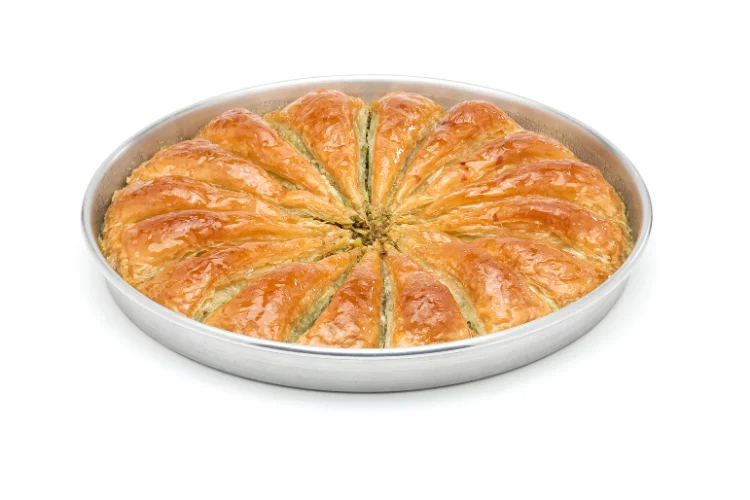
Format flexibility is the third foodservice requirement. Turkish baklava pastry suppliers who can provide full trays for buffet service, individually portioned product for plated dessert menus, and small specialty formats for sharing plates give foodservice operators the tools to present the product across multiple service occasions. The foodservice supply capability of Turkish baklava pastry producers is demonstrated by partnerships with major HoReCa distributors — Hanos, for example, distributes Turkish baklava pastry across a diverse professional foodservice customer base that spans mainstream hospitality and specialist Middle Eastern restaurant accounts.
Turkish Baklava Pastry for Private Label: Building Your Own Brand
Turkish baklava pastry is the strongest foundation available for a private label brand in the European dessert category — a product with authenticated geographic origin, clean label production credentials, and a quality standard that supports premium price positioning without requiring the buyer to make claims that cannot be substantiated.
Genuine private label capability in Turkish baklava pastry means a supplier who can work to a buyer’s specification — adjusting nut content, syrup sweetness, filo thickness, or format — rather than simply relabelling a standard catalogue product. It means packaging management: working with the buyer’s design agency, coordinating packaging production, and managing the labelling compliance requirements across multiple European markets. It means production batch segregation and traceability that protect the buyer’s brand from quality inconsistency.
The qualification test for private label Turkish baklava pastry capability is track record. A supplier currently producing for more than 20 private label brands across European markets has the organisational infrastructure — recipe development, packaging management, multi-market labelling compliance, production scheduling discipline — that a serious private label programme requires. A supplier who is claiming this capability without the operational evidence to back it up will eventually disappoint a private label buyer at the worst possible moment.
FAQ: Everything B2B Buyers Ask About Turkish Baklava Pastry
What type of pastry does baklava use?
Baklava uses filo pastry — also spelled phyllo — an extremely thin, unleavened dough that is layered repeatedly with butter or clarified fat between each sheet. Authentic Turkish baklava pastry from a Gaziantep producer uses filo rolled to a precise, consistent thinness that creates the characteristic crunch and layered texture of the product. The quality of the filo — its thickness consistency, its gluten development, and how it is handled during layering — is one of the primary determinants of finished Turkish baklava pastry quality.
What is Turkish baklava made of?
Authentic Turkish baklava pastry is made from four core ingredients: filo pastry, Antep pistachios or walnuts, real butter applied between filo layers, and a sugar syrup applied after baking. The Antep pistachio — grown in the Gaziantep region of Turkey — is the defining ingredient of the highest-quality Turkish baklava pastry. Serious producers use no preservatives, no artificial additives, and no vegetable fat substitutes. The simplicity of the ingredient list is itself a quality indicator — authentic Turkish baklava pastry does not need artificial stabilisation.
What is the difference between Turkish baklava and regular baklava?
Turkish baklava pastry — particularly from Gaziantep — is characterised by the use of Antep pistachios, pure butter, and a plain sugar syrup that allows the nut flavour to dominate. Greek baklava typically uses honey syrup and walnuts. Arabic baklawa uses rose water or orange blossom syrup and smaller formats. European-produced baklava often uses substitute pistachio varieties and vegetable fat. The Turkish tradition, rooted in Gaziantep production, is generally considered the highest quality expression of the product globally — supported by Protected Geographical Indication status and UNESCO recognition.
Is Turkish baklava healthy?
Turkish baklava pastry is a calorie-dense dessert — a consequence of its real butter, nut, and sugar content. From a clean label perspective, authentic Turkish baklava pastry produced without preservatives or artificial additives is a product made entirely from natural ingredients, which is a meaningful differentiator in the European premium food market. For B2B buyers positioning Turkish baklava pastry in health-conscious retail environments, the clean ingredient list is the relevant health-adjacent claim — not low calorie, but genuinely natural.
What is the difference between Arabic and Turkish baklava?
Turkish baklava pastry uses a plain sugar syrup, tends toward larger piece formats, and prioritises single-nut purity — particularly the Antep pistachio. Arabic baklawa uses rose water or orange blossom syrup, features smaller and more varied piece formats, and often incorporates mixed nut combinations. The texture profile also differs: Turkish baklava pastry tends toward a denser, more intensely buttery product; Arabic baklawa is often lighter with a more prominent floral note. Both are excellent products in their own traditions — but they are distinct, and B2B buyers serving both consumer communities should understand the difference.
Which country has the best baklava?
Turkey — specifically Gaziantep — is the consensus answer among food authorities, culinary historians, and baklava connoisseurs. Gaziantep baklava holds Protected Geographical Indication status under Turkish law. The city holds UNESCO Creative City of Gastronomy status. The Antep pistachio, generational production expertise, and the protected manufacturing tradition concentrated in Gaziantep establish Turkey as the global quality benchmark for Turkish baklava pastry.
Is baklava originally Turkish or Greek?
Baklava has roots across a broad geographic region spanning Anatolia, the Levant, and the Eastern Mediterranean — a culinary heritage that predates modern national borders. The Ottoman Empire played a significant role in spreading and standardising the product across a large geographic area. Both Turkish and Greek culinary traditions claim strong baklava heritage. The Protected Geographical Indication for Gaziantep baklava and the concentration of the world’s most respected Turkish baklava pastry production in Turkey’s Gaziantep region are widely recognised by food historians and culinary authorities.
Why does baklava have 33 layers?
The number 33 carries symbolic significance in several religious and cultural traditions across the region where baklava originated. In practice, authentic Gaziantep Turkish baklava pastry uses between 30 and 40 filo layers — the exact number varies by producer and by product format. The layering count is less important than the consistency of each layer: thin, even filo layers that create the characteristic crunch and flakiness of well-made Turkish baklava pastry require skilled production and proper process control at industrial scale.
Which city is famous for baklava?
Gaziantep, Turkey — without serious competition. The city holds a Protected Geographical Indication for its baklava, UNESCO Creative City of Gastronomy status, and a production infrastructure for Turkish baklava pastry that has no equivalent anywhere in the world. The Antep pistachio growing region surrounding the city, the generational production expertise embedded in its workforce, and the centuries-deep manufacturing culture concentrated there make Gaziantep the undisputed global capital of Turkish baklava pastry production.
What certifications should a Turkish baklava pastry supplier hold?
For European retail supply, BRCGS or IFS Food certification is the standard requirement — major European supermarket chains require it as a trading condition. HACCP is the legal baseline. Halal certification must cover the full product range and be issued by a recognised body. For UK retail specifically, BRCGS is the dominant framework. For German and DACH retail, IFS Food is widely required. Buyers should request current certificates and verify scope per product line.
Can I source Turkish baklava pastry frozen for wholesale?
Yes — and frozen is the recommended format for wholesale Turkish baklava pastry supply. Serious Gaziantep producers freeze at the point of production, maintaining product at -18°C from production through transit and delivery. Frozen Turkish baklava pastry arrives at a European distribution point at the eating quality of freshly made product — without preservatives, without artificial additives, and with the full clean label credentials that premium retail and foodservice positioning requires.
What is the minimum order for Turkish baklava pastry wholesale?
Minimum orders for Turkish baklava pastry wholesale from a Gaziantep producer are typically structured around pallet quantities — one to two pallets per SKU as a starting minimum, with full container quantities representing the most cost-efficient logistics unit. Consolidated ordering across multiple SKUs allows buyers to reach combined volume minimums that individual products may not justify alone. Established accounts with reliable ordering patterns typically access more flexible minimum order terms as the supply relationship develops.
Is Turkish baklava pastry halal?
Authentic Turkish baklava pastry — made from filo, nuts, butter, and sugar syrup — uses ingredients that are inherently halal-compliant. However, formal halal certification requires an independent audit of the full production process, ingredient sourcing, and facility management to confirm that no non-halal inputs or cross-contamination risks are present. Buyers serving Muslim consumer segments should require current halal certification from a recognised body, covering the full ingredient list of every product line they source.
Can I get Turkish baklava pastry under my own brand?
Yes — from a supplier with genuine private label capability. Authentic Turkish baklava pastry from a Gaziantep producer is the strongest available foundation for a private label brand in the European dessert category: protected geographical origin, clean ingredient list, and a quality standard that supports premium pricing. The qualification test for private label suppliers is track record — how many brands are currently being produced, in which markets, and for how long.
Why Lezza Foods
Lezza Foods has been producing Turkish baklava pastry in Gaziantep since 2013 — at the production origin that defines the quality standard of the category. From that foundation, Lezza has built a wholesale supply operation that today serves retail and foodservice clients across more than 20 European countries and manages private label Turkish baklava pastry production for more than 20 brands.
The production standard is uncompromising: Antep pistachios sourced directly in Gaziantep, real butter, authentic Anatolian recipes, no preservatives, no artificial additives. Every Turkish baklava pastry product leaves the Gaziantep facility frozen and is shipped to European distribution points via documented cold chain logistics — arriving at the quality standard that Gaziantep production delivers, not at the quality standard that preservative stabilisation permits.
The retail track record speaks to the commercial viability of Lezza Foods’ Turkish baklava pastry at scale. Retail partnerships with major chains including Aldi and Kaufland in the European market demonstrate production quality and delivery reliability that demanding retail accounts require. The foodservice partnership with Hanos — one of Europe’s leading HoReCa distributors — confirms that Lezza Foods’ Turkish baklava pastry meets the operational standards of professional foodservice supply across a diverse and demanding customer base.
The full Turkish baklava pastry range — pistachio baklava in classic and specialty cuts, walnut baklava, cashew baklava, kadaifi, künefe, bird’s nest formats, rolled formats, and assorted gift configurations — is available from a single supply relationship. The private label programme, currently operational for more than 20 brands across European markets, provides the custom specification, packaging management, and production discipline that serious branded product development requires.
For B2B buyers ready to source Turkish baklava pastry from a Gaziantep producer with the range, scale, and European logistics infrastructure to support their commercial requirements, the product catalogue is available at lezzafoods.eu.

Conclusion
Turkish baklava pastry is the quality ceiling of the baklava category — the product that, when produced authentically in Gaziantep with Antep pistachios, real butter, and no preservatives, outperforms every alternative in European retail and foodservice on the criteria that matter: flavour intensity, textural quality, clean label credentials, and the provenance narrative that supports premium price positioning.
For European B2B buyers, sourcing Turkish baklava pastry correctly means sourcing from Gaziantep, from a producer who has made the investment in production infrastructure, quality management, and European logistics that wholesale supply at scale demands. The qualification process — verifying production origin, certifications, range depth, cold chain capability, and private label infrastructure — is the investment that separates supply relationships that perform from those that disappoint.
The commercial return on getting that sourcing decision right compounds across every order in the relationship. Turkish baklava pastry from the right Gaziantep producer is not just a product — it is the foundation of a category that will continue to grow in European retail and foodservice for years to come.