Turkish Breakfast for Hotels and Cafés: How to Build a Menu That Sells
Turkish breakfast is one of the most commercially powerful food concepts available to European hotel and café operators right now. It is visually striking, culturally credible, operationally straightforward, and — perhaps most importantly — it is something that a growing number of European guests actively seek out and return for.
This guide is for hotel F&B managers, café operators, HoReCa procurement teams, and wholesale distributors who want to understand exactly what a Turkish breakfast concept involves, how to build it profitably on a European menu, what to source and from whom, and why the timing for introducing it has never been better.
What Is Turkish Breakfast?
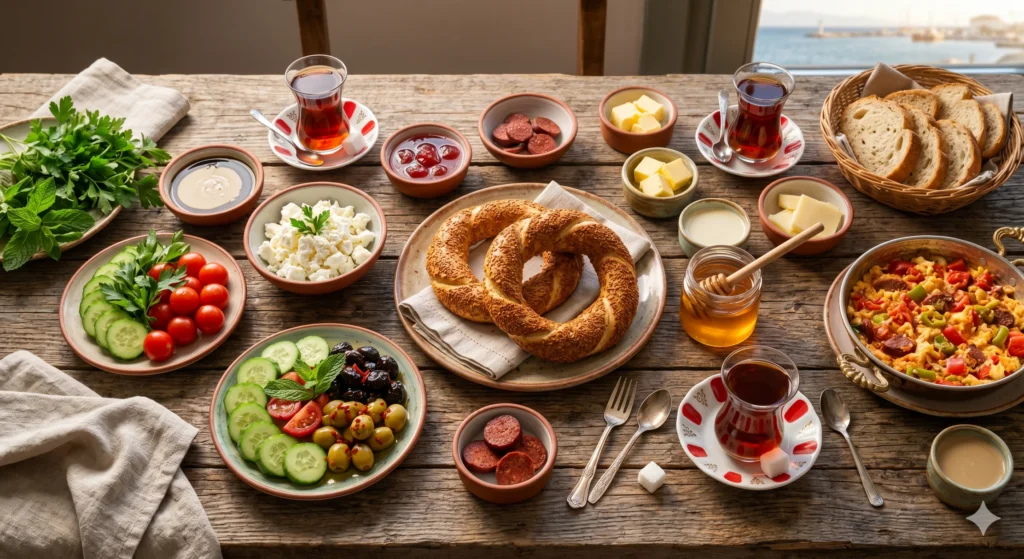
Turkish breakfast — known in Turkey as kahvaltı — is a shared morning meal built around a wide variety of small dishes served simultaneously rather than in courses. Where a standard European breakfast is typically one or two items — eggs, toast, a pastry — a Turkish breakfast is a spread: multiple small plates covering bread, cheese, olives, vegetables, eggs, honey, preserves, and tea, all presented together at the table.
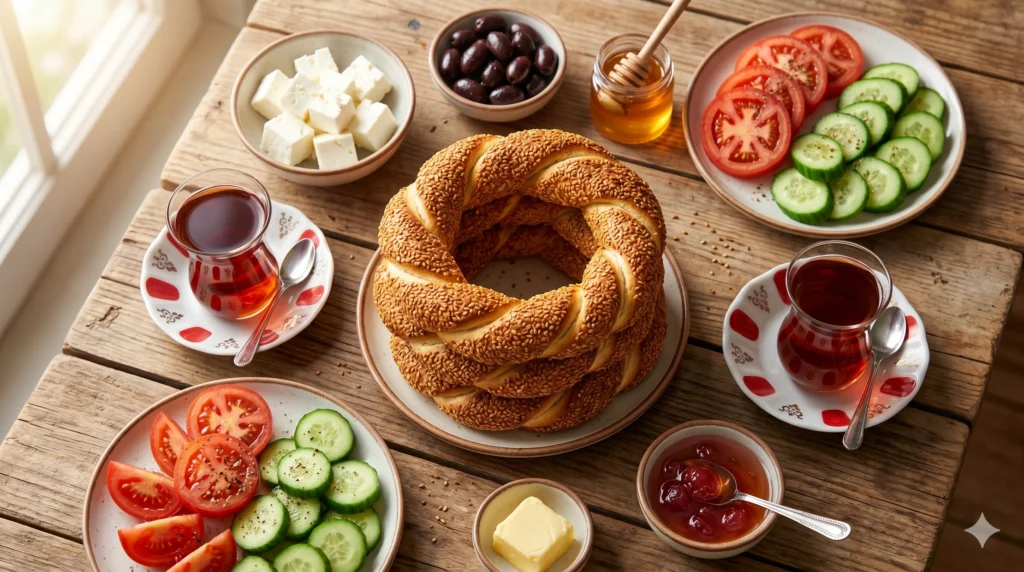
The centrepiece of any authentic Turkish breakfast is bread — specifically simit, the sesame-coated bread ring that has been Turkey’s most consumed street food for centuries. A Turkish breakfast without simit is, for most Turks, simply incomplete. The golden ring, its surface thick with toasted sesame, sits at the heart of the spread and is the item guests reach for first.
Beyond simit, a traditional Turkish breakfast typically includes white cheese (beyaz peynir), a selection of olives — both green and black — sliced tomatoes and cucumbers, a soft-boiled or pan-scrambled egg dish (menemen), honey, and fruit preserves. Strong black tea served in tulip-shaped glasses is the essential accompaniment. Turkish coffee may follow.
What makes Turkish breakfast commercially compelling for European operators is not the complexity of the spread — it is the combination of simplicity, authenticity, and visual impact. The components are easy to source, easy to plate, and instantly recognisable as something special to a guest who has never encountered it before.
Why Turkish Breakfast Is Winning European Menus in 2026
Turkish breakfast has moved from a niche diaspora occasion to a mainstream European menu trend over the past three years, and the trajectory in 2026 is clearly upward. Several structural factors are driving this.
The Trend Data Is Compelling
European and UK hospitality market research consistently identifies Turkish breakfast as one of the fastest-growing international breakfast concepts in the hotel and café sector. The format has transitioned from specialist Turkish restaurants and diaspora-serving establishments to premium independent hotels, lifestyle café groups, and all-day dining restaurants across London, Amsterdam, Berlin, Brussels, and Paris.
Research published in early 2026 by hospitality industry analysts confirms that international breakfast formats — led by Turkish breakfast alongside shakshuka and congee — are among the top breakfast innovation priorities for European hotel F&B teams this year. Operators who introduced the concept in 2024 and 2025 report strong guest satisfaction scores and above-average repeat ordering rates compared to standard breakfast items.
European Consumers Are Ready
A decade of sustained growth in Mediterranean and Middle Eastern food across European retail and food service has prepared the European consumer for Turkish breakfast in a way that simply did not exist five years ago. Hummus, labneh, za’atar, halloumi, baklava — ingredients and products once confined to specialist shops are now mainstream. The consumer encountering a Turkish breakfast spread for the first time in 2026 has almost certainly already eaten several of its components in other contexts. The format feels adventurous but accessible.
Social media has been a significant driver. Turkish breakfast spreads are among the most photographed and shared food content from European travel, and that visibility has created active demand among consumers who want to experience the format at home or in their local city. Operators who offer Turkish breakfast are increasingly visible in the food content that drives booking decisions and footfall.
The Timing Advantage
There is a first-mover advantage available to European operators who introduce Turkish breakfast now, before it becomes standard across the sector. Hotels and cafés that establish a credible Turkish breakfast offering in 2026 will build the guest habit and the reputation ahead of competitors who follow later. The window for differentiation through this concept is open — but it will not remain open indefinitely.
Turkish breakfast spread on a hotel table — simit, white cheese, olives, tomatoes and tea
The Components of an Authentic Turkish Breakfast
Understanding what a Turkish breakfast actually comprises — and which components are essential versus optional — is the starting point for building a commercially viable version in a European food service context.
The Non-Negotiables
Simit — the sesame bread ring — is the anchor product. No Turkish breakfast concept works without it. The golden, molasses-glazed, sesame-coated ring is both the most recognisable visual element of the spread and the most frequently eaten component. In a food service context, simit sourced in frozen format and finished in the oven delivers a product that is indistinguishable from freshly baked — and it requires minimal kitchen preparation.
White cheese is the second essential. In Turkey, this is beyaz peynir — a brined, semi-firm white cheese with a mild, slightly salty flavour. In European food service, good-quality feta is the most accessible and cost-effective equivalent. Bulgarian white cheese or domestic varieties of brined cheese work well depending on the operator’s sourcing geography.
Olives — a selection of both green and black — are present on every authentic Turkish breakfast table. They require no preparation and add visual variety, flavour contrast, and cultural authenticity to the plate.
Sliced tomatoes and cucumbers are standard components. Fresh, simply presented, they provide colour and contrast and signal the fresh, unprocessed character of the format.
Eggs in some form are expected. Menemen — scrambled eggs cooked with tomatoes, peppers, and olive oil — is the most authentically Turkish option and can be prepared ahead in quantity for buffet service. Soft-boiled eggs are an operationally simpler alternative.
Honey and preserves — a small portion of good honey and one or two fruit preserves — round out the savoury spread with a sweet element. These require no kitchen preparation and are easy to portion.
Black tea is essential. Turkish breakfast without tea is like a French breakfast without coffee. Served in small tulip-shaped glasses if available, or in standard tea cups, strong black tea is the drink that ties the spread together and extends the guest’s time at the table.
The Enhancements
Beyond the non-negotiables, a more elaborate Turkish breakfast spread can include börek — a flaky, layered pastry filled with white cheese or spinach — sucuk (cured beef sausage), pastırma (cured meat), kaymak (clotted cream) with honey, a nut and dried fruit assortment, and Turkish coffee as a closing beverage.
For European food service operators, these enhancements offer menu upsell opportunities and allow the Turkish breakfast concept to be tiered — a standard version and a premium version — at different price points on the same menu.
How to Build a Turkish Breakfast Menu for Your Operation
The practical architecture of a Turkish breakfast menu depends on the service format. Hotels, cafés, and restaurants each have different operational requirements, and the Turkish breakfast concept adapts to all three.
Hotel Breakfast Buffet
The buffet is the highest-volume application for Turkish breakfast in European food service. A dedicated Turkish breakfast station on a hotel buffet — clearly labelled, well-merchandised, and visually coherent — drives guest engagement and elevates the overall perception of the breakfast offering.
A buffet-format Turkish breakfast station should include at minimum: freshly baked simit, white cheese, olives, sliced tomatoes and cucumbers, honey, and a fruit preserve. Menemen can be offered from a chafing dish. Tea should be available from the main beverage station.
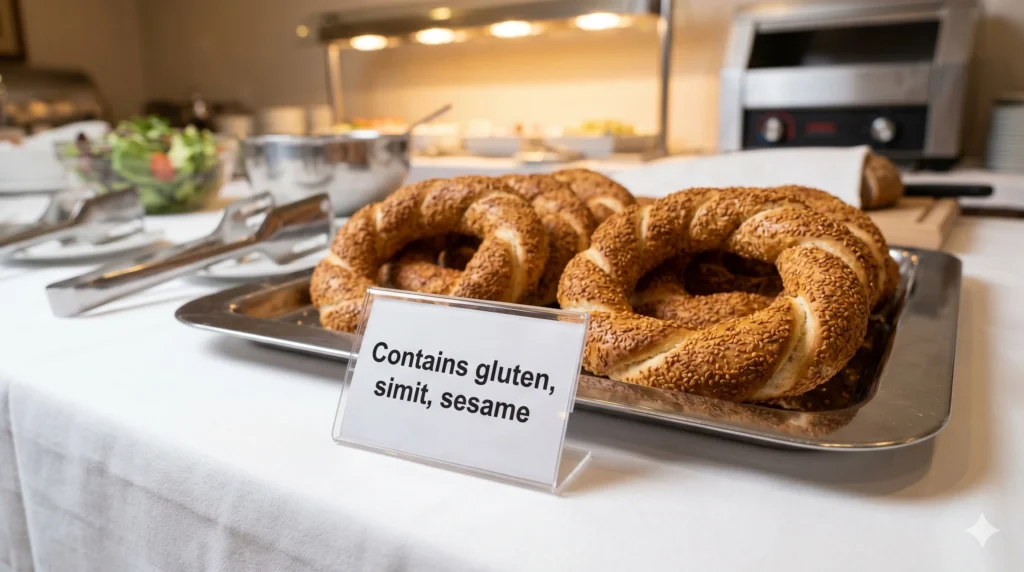
The station should be visually merchandised as a destination — a distinct zone within the buffet with its own signage, its own aesthetic identity, and enough visual density to draw a guest’s eye from across the room. A tray of golden simit rings is one of the most visually striking elements any breakfast buffet can offer. Place it at the front of the station.
Operationally, simit baked from frozen in batches throughout service maintains quality and minimises waste. A 20-minute baking rotation using a standard convection oven is sufficient for most hotel breakfast volumes.
À La Carte and Plated Turkish Breakfast
For restaurants and all-day cafés, Turkish breakfast served as a plated dish or board is a premium menu item that commands a price point well above the standard breakfast. A plated Turkish breakfast for one — simit, white cheese, olives, tomatoes, a portion of menemen, honey, and a glass of tea — is a complete, visually impressive dish that guests photograph, share, and return for.
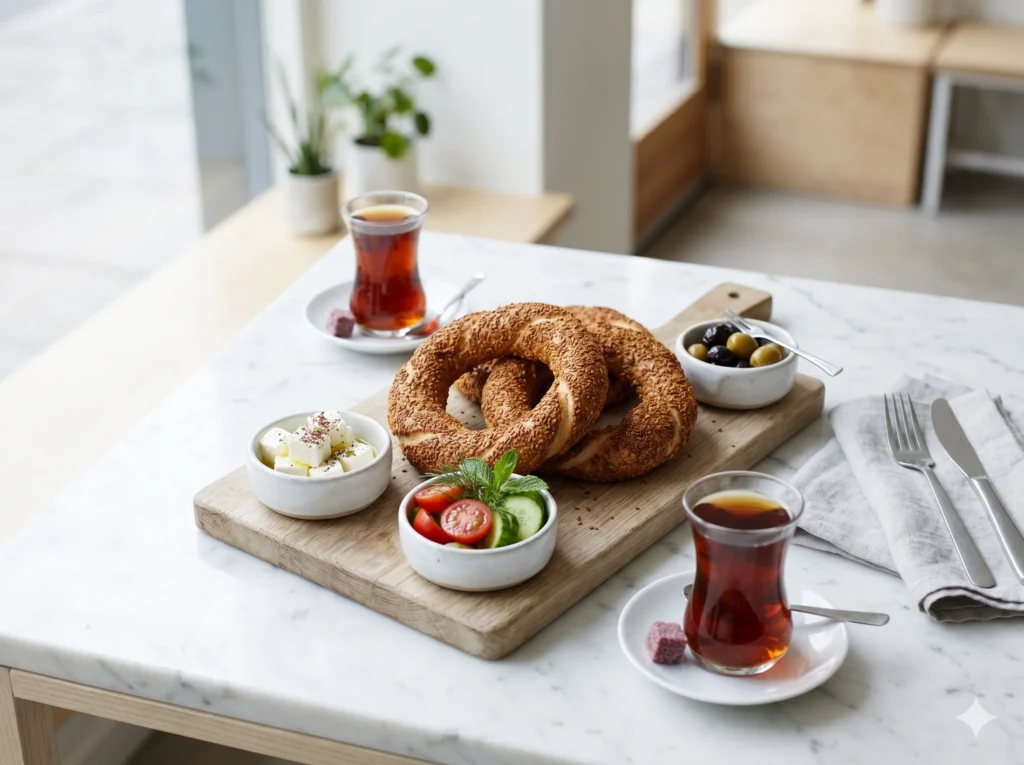
For two guests, a sharing Turkish breakfast board — a wooden board or slate spread with all components — is a particularly strong brunch offering. The sharing format encourages lingering at the table, increases beverage attachment, and creates a social experience that guests associate with the restaurant rather than simply the food.
Pricing a sharing Turkish breakfast board at a 20–30% premium above standard à la carte breakfast items is commercially justifiable and consistently accepted by consumers who understand what they are ordering. Clear menu description and, where possible, a visual reference on the menu drive ordering rates significantly.
Café Counter and Simplified Format
For café operators who want to offer Turkish breakfast without the full spread, a simplified format works well: a warm simit, a portion of white cheese, olives, and a glass of tea, presented as a “Turkish breakfast” item. This can be prepared and plated in under two minutes, requires no specialist equipment, and offers a strong margin relative to the component cost.
This simplified format performs particularly well for the late-morning café occasion — guests arriving after 10am who want something more substantial than a pastry but lighter than a full cooked breakfast. Turkish breakfast in this format fits naturally into the premium café daypart and distinguishes the operator from competitors whose breakfast menu ends at 11am.
Turkish breakfast board for two at a café — simit, cheese, olives and tea
Sourcing Turkish Breakfast Ingredients in Europe
Building a credible Turkish breakfast menu requires sourcing components that are authentically produced, consistently available, and commercially viable at the volumes your operation requires.
Simit: The Priority Sourcing Decision
Simit is the component that makes or breaks a Turkish breakfast concept. Every other ingredient is available from standard wholesale suppliers. Simit — specifically, simit produced to authentic Turkish specification — requires a specialist supplier.
The key sourcing decision for simit is frozen versus fresh. Fresh simit has a shelf life measured in hours — it is at its best within two to three hours of baking and deteriorates quickly. At European wholesale scale, consistent fresh simit supply is not commercially practical for most operators.
Frozen simit, produced by specialist manufacturers and finished in your own oven, is the operationally practical solution. Well-produced frozen simit — baked to 80% completion, blast-frozen, and finished in a preheated oven for 5 to 8 minutes — delivers a product that is genuinely indistinguishable from freshly baked. This is the format used by hotel breakfast operations, café groups, and catering businesses across Europe.
When evaluating a frozen simit supplier, the criteria are consistent quality across batches, authentic recipe and production method, EU-based supply chain for cold chain reliability, and private label capability if your operation wants to serve the product under its own brand.
White Cheese
Good-quality feta — PDO-certified where possible — is the most accessible and commercially viable white cheese for a European Turkish breakfast. Bulgarian white cheese is a cost-effective alternative with a similar flavour profile. Some specialist wholesale suppliers also carry authentic Turkish beyaz peynir for operators who want maximum authenticity.
For buffet service, pre-portioned white cheese reduces preparation time and allergen management complexity. For plated service, a small block or crumbled portion presented with olive oil and dried herbs elevates the component visually.
Olives, Tomatoes, and Cucumbers
These components are available from any standard wholesale supplier. For Turkish breakfast, quality matters more than exoticism — good mixed olives (not canned), firm tomatoes sliced to order, and fresh cucumbers presented simply. The visual freshness of these components is what communicates the quality of the spread to the guest.
Eggs and Menemen
Menemen — scrambled eggs with tomatoes and peppers — can be batch-prepared for buffet service or cooked to order for plated service. The recipe is simple: eggs, canned or fresh tomatoes, green peppers, olive oil, salt. It scales easily and holds well in a chafing dish for up to one hour of service. For café operators without a kitchen, soft-boiled eggs are a simpler alternative that requires no cooking infrastructure beyond a pot of boiling water.
Tea
Black tea served in the Turkish style requires only a good-quality black tea blend and appropriate glassware. Turkish tulip-shaped tea glasses are available from catering equipment suppliers across Europe and cost very little per unit. They are a strong visual signal to guests that the Turkish breakfast concept has been thought through with authenticity in mind.
For operators who want to source Turkish tea specifically — çay — specialist Turkish wholesale food suppliers carry a range of commercial tea options suitable for food service.
Costing and Pricing a Turkish Breakfast Menu
Understanding the component costs of a Turkish breakfast is essential for building a commercially viable menu item.
Component Cost Breakdown (Indicative)
The following is a general cost framework for a single-serve plated Turkish breakfast. Actual costs will vary by market, supplier, and volume:
Simit (1 ring, frozen): Low per-unit wholesale cost at carton quantities — typically among the most cost-effective premium bakery items available
White cheese (40–50g portion): Competitive with standard European breakfast cheese costs
Olives (30g mixed): Standard wholesale cost
Tomato and cucumber (sliced, 1 portion): Minimal cost
Egg / menemen (1 portion): Standard breakfast egg cost
Honey and preserve (small portions): Minimal cost
Black tea: Very low per-glass cost at wholesale tea pricing
The total component cost of a plated single-serve Turkish breakfast — even using premium ingredients — is competitive with a standard European cooked breakfast. The difference is the menu positioning. Turkish breakfast commands a higher menu price than a standard cooked breakfast because of its perceived premium character, its cultural authenticity, and its visual impact.
Pricing Strategy
For hotel buffets, Turkish breakfast adds a dedicated station that can be used to justify a tiered buffet pricing model — a standard rate and a premium rate that includes access to the Turkish breakfast station. For most European hotel markets, a 10–15% premium tier for a buffet that includes a dedicated Turkish breakfast station is commercially viable and well-accepted by guests.
For café and restaurant plated service, pricing Turkish breakfast at 15–25% above standard breakfast items is consistently achievable in markets where the concept is positioned correctly. A clearly described menu item — “Authentic Turkish Breakfast: warm simit, white cheese, mixed olives, menemen, honey, and a glass of black tea” — sets guest expectations and justifies the premium without requiring explanation from front-of-house staff.
For sharing boards, a 30–40% premium above individual breakfast items is standard across European operators who have successfully introduced the format.
Menu Description and Guest Communication
How a Turkish breakfast is described on the menu significantly affects both ordering rates and guest satisfaction.
What Works
Descriptions that work combine the authentic name, the key components, and one evocative phrase that signals the experience:
“Turkish Breakfast (Kahvaltı) — warm simit, white cheese, olives, tomato, menemen, honey, and black tea. A morning tradition from Istanbul.”
“The Istanbul Spread — sesame bread, cheese, olives, fresh vegetables, eggs, and tea, served as a shared morning table.”
“Turkish Breakfast for Two — a shared spread of warm simit, beyaz peynir, mixed olives, sliced vegetables, menemen, honey, preserves, and a pot of black tea.”
What to Avoid
Avoid descriptions that are vague (“Mediterranean breakfast platter”), that use only component lists without cultural context, or that position the concept as exotic or unfamiliar. European consumers in 2026 are comfortable with the concept of Turkish breakfast — they want authenticity and clarity, not reassurance.
For buffet stations, clear point-of-display labels with ingredient lists and allergen declarations are both legally required and commercially beneficial. Guests who understand what they are looking at are significantly more likely to engage with the station.
Turkish Breakfast and Allergen Compliance
Turkish breakfast contains several components that carry regulated allergen declarations under EU food labelling law.
Simit contains gluten (wheat) and sesame — both mandatory declared allergens. Sesame has been a regulated allergen in the EU since 2022 under the relevant food information regulation. Any menu, buffet label, or guest allergen sheet that includes simit must declare both.
White cheese contains milk — a regulated allergen. Börek, if included, contains gluten (wheat) and typically milk and eggs.
Eggs (in menemen) are a regulated allergen.
For buffet service, each component of the Turkish breakfast station must be individually labelled with allergen information. For plated service, the allergen information must be available in written form on request. For operations that need to review their allergen management framework, relevant guidance is published by national food safety authorities across EU member states — including guidance specific to HoReCa allergen communication obligations.
Always obtain a current product specification sheet from each supplier for each component you source. Do not rely on general category descriptions for allergen declarations.
Turkish breakfast board for two at a café — simit, cheese, olives and tea
Why Lezza Foods for Your Turkish Breakfast Supply
Lezza Foods BV has been manufacturing and supplying authentic Turkish and Mediterranean food products to European HoReCa and retail markets since 2013. Based in Mechelen, Belgium, with distribution across 20+ European countries and more than 20 private label brands in production, Lezza Foods is one of Europe’s established specialists in the authentic Anatolian bakery products that form the core of any kahvaltı concept.
For operators building this kind of morning menu, the starting point is always simit — and Lezza Foods supplies it in a frozen format engineered for European food service requirements.
The 125g classic simit is the core SKU for HoReCa operations: 80 pieces per carton, consistent ring size, proven performance across standard convection and deck ovens. It is the format that hotel breakfast operations across Europe rely on for their Turkish breakfast stations.
For operators who want to offer a sweeter simit alongside the classic — appropriate for a dessert concept, an afternoon tea adaptation, or a family-oriented buffet — the sweet simit range is available in 135g and 160g formats, with the larger size suited to premium plated presentations.
Beyond simit, Lezza Foods supplies a broader range of Anatolian bakery products — including börek variants — that extend the concept beyond the core spread into more elaborate menu formats. Browse the full Lezza Foods product range to explore all available SKUs relevant to a Turkish breakfast programme.
All products are available for private label. Wholesale enquiries are welcome from hotel procurement teams, café groups, catering businesses, and wholesale distributors across Europe.
Turkish Breakfast as a Revenue Strategy: The Numbers
For operators who need to make an internal business case for introducing the concept, the commercial argument can be made in clear numerical terms.
Buffet Revenue Impact
A dedicated station on a hotel breakfast buffet that serves 100 covers per morning, with 30% of guests engaging, represents 30 Turkish breakfast experiences per service. If those 30 engagements justify a per-cover buffet premium of €2–3, the station generates €60–90 of incremental revenue per morning service. Across a 300-day operating year, that is €18,000–27,000 of additional revenue from a single station addition.
These are conservative estimates. Hotels that have introduced a dedicated Turkish breakfast station typically report engagement rates of 40–60% among guests who encounter the concept for the first time — particularly in properties with a diverse international guest mix.
Plated Menu Revenue Impact
For a café or restaurant serving 30 breakfast covers per morning with the concept on the menu at a €18–22 price point, conversion of 5 covers per service versus a standard €12–14 breakfast item represents an incremental revenue of €20–40 per morning service. At 300 operating days, this is €6,000–12,000 per year from a single menu item addition.
Guest Satisfaction and Return Rate
Beyond direct revenue, Turkish breakfast consistently generates disproportionate positive impact on guest satisfaction scores and online reviews. A memorable morning experience drives ratings, recommendations, and return bookings in ways that are commercially significant but difficult to quantify precisely. For hotel operators managing OTA scores and review platforms, breakfast differentiation is one of the highest-leverage levers available.
Frequently Asked Questions: Turkish Breakfast for HoReCa
How long does it take to set up a Turkish breakfast station from scratch?
With the right supplier relationships and a clear menu plan, a hotel breakfast team can introduce the concept within two to four weeks. The main lead time is establishing a reliable frozen simit supply and sourcing white cheese and olives through existing wholesale channels. Staff training for the station requires no more than a half-day briefing.
Is Turkish breakfast suitable for guests with dietary requirements?
The spread is naturally accommodating for many dietary requirements. The core is gluten-present (simit, börek) but the non-bread components — cheese, olives, vegetables, eggs, honey — are naturally gluten-free and suitable for a range of dietary profiles. Menus and buffet labels should clearly declare all allergens, and operators should be able to point guests to allergen information for every component on request.
Can we offer a Turkish breakfast with our existing kitchen equipment?
Yes. Frozen simit finishes in any standard convection oven. Menemen requires only a pan and a hob. Every other component requires no cooking at all — it is simply sourced, portioned, and plated. The concept is one of the most kitchen-friendly menu additions available precisely because it requires minimal preparation infrastructure.
What is the ideal price point for a Turkish breakfast in a European café?
This varies by market and positioning. In the UK, Netherlands, Germany, Belgium, and France, plated single-serve items are typically priced in the €12–18 range in café settings. Sharing boards for two are typically priced €20–32. Premium hotel à la carte positions are often higher. Research competitor breakfast pricing in your specific market and position the concept at the higher end of that range, justified by its premium components and cultural distinctiveness.
Is Turkish breakfast seasonal?
No — it is a year-round menu concept. It performs consistently across all seasons, hearty enough for winter and fresh enough for summer. The core components are all year-round products with no seasonal sourcing challenge.
Where can we source frozen simit for our Turkish breakfast programme?
Lezza Foods BV supplies frozen simit wholesale to HoReCa operators across 20+ European countries. Contact the team to discuss carton quantities, lead times, and whether supply can be arranged through your existing wholesale distributor relationships.
Ready to Build Your Turkish Breakfast Programme?
Turkish breakfast is the right concept at the right moment for European HoReCa operators who want to differentiate their morning offering, drive guest satisfaction, and build a menu item that guests return for.
The components are accessible, the operational demands are minimal, the guest experience is memorable, and the commercial case is clear. For operators who move now, there is a genuine first-mover advantage in most European markets.
Lezza Foods has been supplying the core components of a Turkish breakfast concept to European food service since 2013. The frozen simit range is consistent, EU-sourced, available in formats suited to every HoReCa operation, and ready for private label.
Download the wholesale catalogue for full product specifications and carton configurations, or request a quote directly for Turkish breakfast supply pricing and private label enquiries.
To provide the best experiences, we use technologies like cookies to store and/or access device information. Consenting to these technologies will allow us to process data such as browsing behavior or unique IDs on this site. Not consenting or withdrawing consent, may adversely affect certain features and functions.
Functional
Always active
The technical storage or access is strictly necessary for the legitimate purpose of enabling the use of a specific service explicitly requested by the subscriber or user, or for the sole purpose of carrying out the transmission of a communication over an electronic communications network.
Preferences
The technical storage or access is necessary for the legitimate purpose of storing preferences that are not requested by the subscriber or user.
Statistics
The technical storage or access that is used exclusively for statistical purposes.The technical storage or access that is used exclusively for anonymous statistical purposes. Without a subpoena, voluntary compliance on the part of your Internet Service Provider, or additional records from a third party, information stored or retrieved for this purpose alone cannot usually be used to identify you.
Marketing
The technical storage or access is required to create user profiles to send advertising, or to track the user on a website or across several websites for similar marketing purposes.