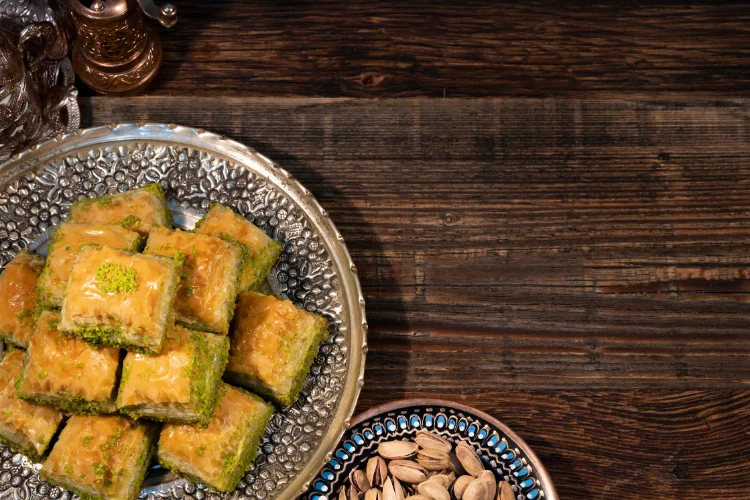
Wholesale baklava is not a single sourcing problem. A supermarket buyer building a Mediterranean dessert range, a hotel procurement manager sourcing frozen desserts for a buffet operation, and a food brand developing a private label baklava line are all looking for wholesale baklava — but what they need from a supplier, and how they should evaluate one, is fundamentally different in each case.
This distinction matters because the European wholesale baklava market has grown into a category with three distinct buyer segments, each pulling in a different direction. Retail buyers need consistent volume, shelf-ready packaging, and the range depth to build a category. Foodservice buyers need portion consistency, frozen convenience, and format flexibility. Private label buyers need recipe control, custom packaging capability, and production discipline. A wholesale baklava supplier who is genuinely set up to serve all three segments is a commercially rare thing — and for buyers who operate across more than one segment, or who anticipate moving into additional segments as their business grows, finding that supplier is worth the additional qualification effort.
This guide maps the requirements of each segment in detail, explains why production origin and frozen cold chain supply matter across all three, and makes the case for why consolidating wholesale baklava sourcing under a single capable producer is the most commercially rational approach for serious B2B buyers.
The European Wholesale Baklava Market: One Product, Three Distinct Buyer Segments
The European market for wholesale baklava has changed significantly over the past decade. Ten years ago, the majority of wholesale baklava moving through European supply chains was destined for ethnic food retail and specialist Middle Eastern restaurants — a relatively contained segment served by a small number of importers and Turkish food traders.
Today the picture is entirely different. Wholesale baklava is a mainstream commercial category. Major supermarket chains across Germany, the Netherlands, France, Belgium, and the UK carry it as a permanent range item. Hotel groups and catering companies include it in standard dessert programmes. Premium food brands have identified it as a private label opportunity with strong margin potential. The wholesale baklava market has not just grown — it has diversified, and that diversification has created three buyer segments with genuinely different sourcing requirements.
The retail segment has grown fastest in volume terms. Mainstream supermarkets, discount retailers, and online grocery platforms have all invested in the category, driving demand for wholesale baklava at scales that only a few years ago were the preserve of specialist importers. The foodservice segment has grown in complexity — as baklava has moved from ethnic restaurant menus into hotel buffets, premium casual dining, and catering programmes, the format and packaging requirements have multiplied. And the private label segment has emerged from almost nothing into a commercially significant portion of the total wholesale baklava market, as retailers and food brands have recognised the margin and brand equity advantages of own-label production.
Understanding which segment a buyer is operating in — and what that segment specifically requires from a wholesale baklava partner — is the foundation of a sourcing decision that holds up over time.
Wholesale Baklava for Retail: What Supermarkets and Specialty Stores Actually Need
Retail buyers sourcing wholesale baklava operate under a set of requirements that are more demanding and more specific than buyers in other segments. Getting wholesale baklava onto a supermarket shelf and keeping it there is a multi-dimensional challenge — and the wholesale baklava supplier who cannot meet all of its dimensions will not hold a retail listing for long.
Volume consistency is the first requirement, and it is non-negotiable. A retail buyer who has committed shelf space to wholesale baklava cannot manage stock-outs. The wholesale baklava producer supplying a retail account must be able to deliver consistent volume across every replenishment order, through seasonal demand peaks — Ramadan, Christmas, Easter — and across the multiple SKUs that a retail range requires. A producer who performs well on initial orders but cannot sustain volume through peak periods is a producer who will cost a retail buyer their category plan.
Packaging and labelling compliance is the second requirement. Wholesale baklava entering European retail must arrive in shelf-ready packaging that meets the design and structural standards of modern retail environments, with labelling that complies with EU food information regulations across all relevant markets. For buyers placing wholesale baklava in multiple European countries, this means a producer who understands — and can manage — the language requirements, allergen declaration formats, and nutritional labelling standards that differ between markets. Placing the compliance burden entirely on the buyer is not acceptable from a serious wholesale baklava producer.
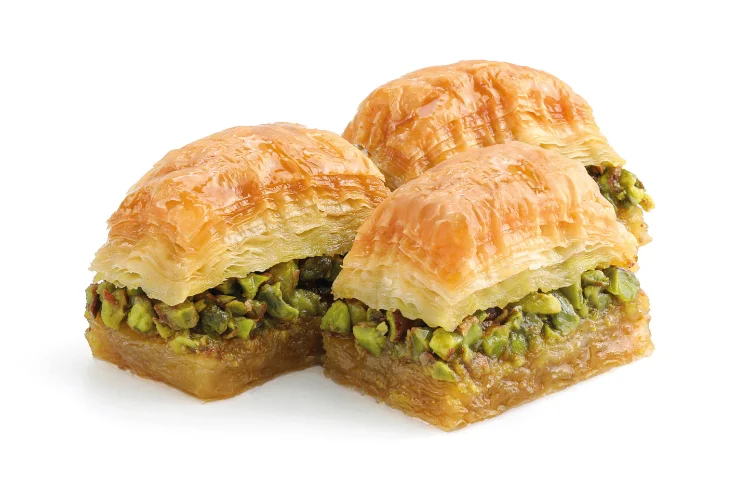
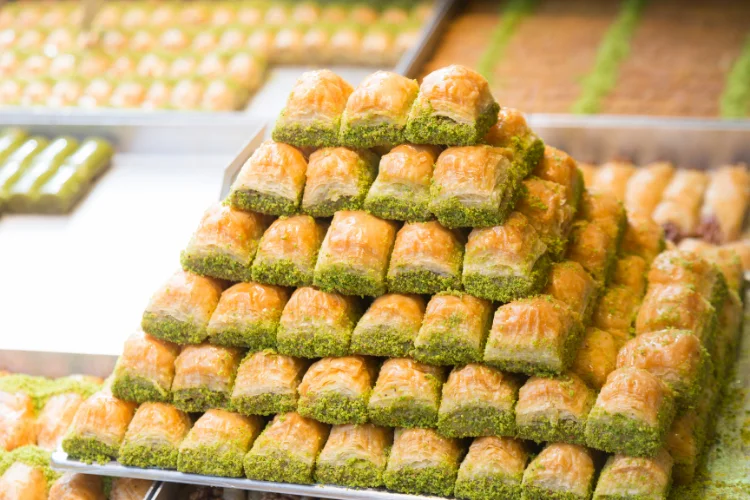
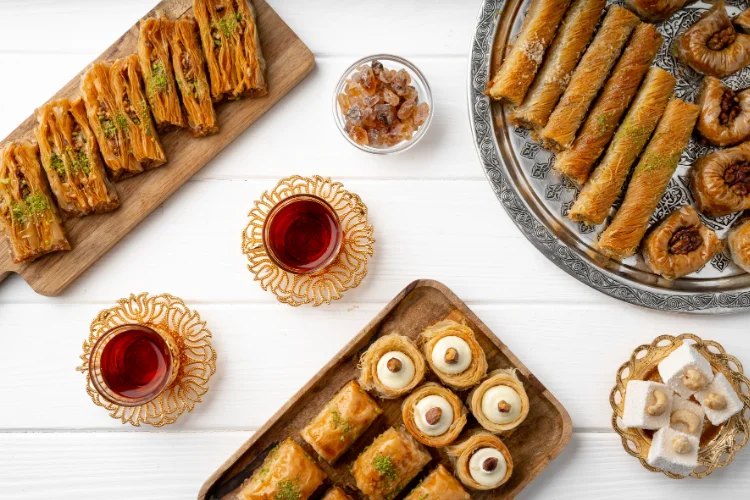
Range depth is the third requirement. A wholesale baklava range that covers only pistachio in one or two cuts gives a retail buyer limited tools to build a category. A producer who can supply pistachio, walnut, cashew, kadaifi, künefe, bird’s nest formats, assorted gift boxes, and seasonal configurations gives a retail buyer the range architecture to develop a genuine category — with variety that drives repeat purchase, gifting formats that perform in key seasonal windows, and premium lines that support higher price points alongside volume-driving core SKUs.
Clean label and provenance are the fourth requirement — and their commercial importance in retail has grown substantially. A wholesale baklava supplier who can offer preservative-free product with a documented Gaziantep origin gives retail buyers a differentiation story that shelf positioning alone cannot deliver. In an increasingly label-conscious retail environment, the ability to present wholesale baklava as a product made from natural ingredients, without additives, in the authentic production capital of the world, is a genuine commercial asset.
Wholesale Baklava for Foodservice: What Restaurants, Hotels, and Caterers Require
The foodservice segment’s requirements for wholesale baklava are shaped by the operational realities of professional kitchen and service environments — which are fundamentally different from the requirements of retail supply.
Portion consistency is the primary operational requirement for foodservice wholesale baklava buyers. Every piece of baklava served to a guest must meet the same standard: same dimensions, same filling, same syrup balance, same eating quality. A wholesale baklava producer whose production controls deliver this consistency at scale is a producer who reduces kitchen quality management burden. One who does not is a producer who creates operational problems every time a service team has to manage inconsistent product.
Frozen convenience is the second requirement that distinguishes foodservice wholesale baklava sourcing from retail. Professional kitchens do not want to manage ambient or short-shelf-life chilled baklava with narrow service windows. Frozen wholesale baklava from a serious producer can be thawed to order, managed in stock rotation without waste pressure, and served at consistent quality whether the kitchen is running a lunch service or a banquet for five hundred. The operational flexibility of frozen product is a genuine advantage in foodservice environments — it is the format that professional buyers should be sourcing, not a compromise.
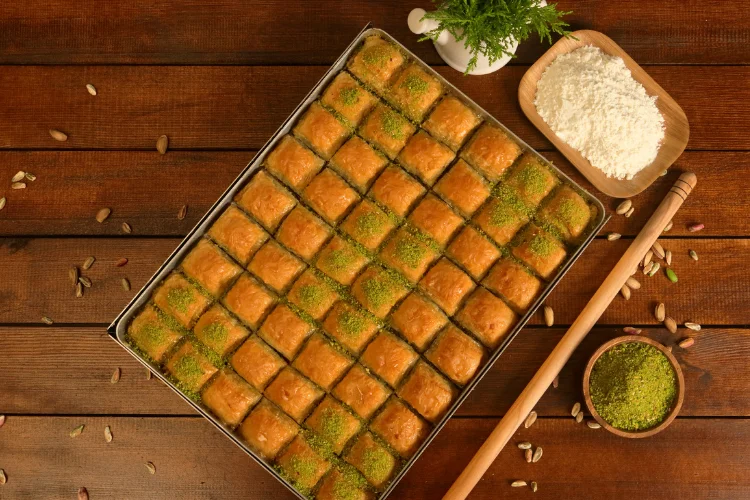
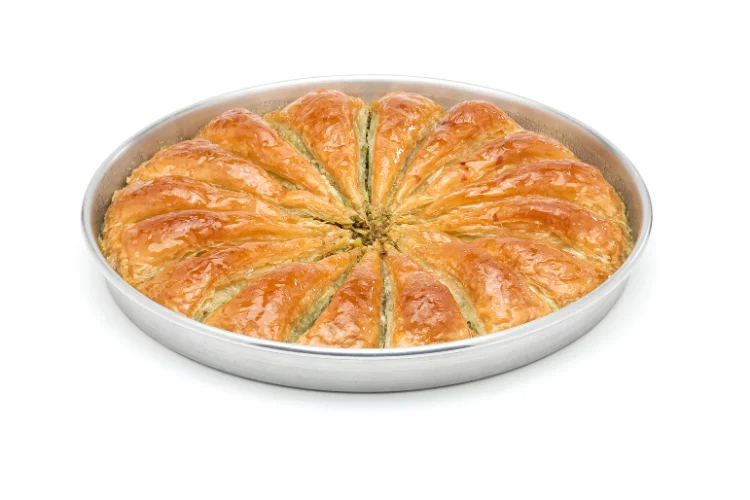
Format flexibility is the third foodservice-specific requirement. A wholesale baklava producer who can supply full trays for buffet service, individually portion-cut product for plated dessert menus, smaller format pieces for afternoon tea or dessert sharing plates, and retail-format packaging for hotel room service or in-room gifting is a producer who simplifies a foodservice buyer’s supply base considerably. Managing all of these formats through a single wholesale baklava relationship — one delivery, one invoice, one quality management process — is operationally more efficient than maintaining separate supplier relationships for each format requirement.
Lead time reliability completes the foodservice requirement set. A hotel group managing events across multiple properties, or a catering company operating on fixed-menu contracts, cannot absorb unpredictable lead times from their wholesale baklava supplier. The supplier must be able to commit to delivery schedules and hold to them — and must communicate proactively when constraints arise, rather than allowing a foodservice buyer to discover a supply problem at the point of order.
Wholesale Baklava for Private Label: What Brands and Retailers Building Own-Label Ranges Need
Private label wholesale baklava is a different sourcing problem from retail or foodservice supply, and it requires a different kind of producer relationship. The buyers entering this segment are not just looking for consistent product at scale — they are looking for a manufacturing partner who can help them build a branded product range, and whose production discipline ensures that the brand promise is delivered in every batch.
The starting point for private label wholesale baklava sourcing is recipe ownership. A private label buyer needs a producer who can work to the buyer’s specification — adjusting nut content, syrup sweetness, filo thickness, portion size, or format to match a brief — rather than offering a standard catalogue product with a different label applied. This requires a wholesale baklava producer with genuine recipe development capability and the production controls to enforce a custom specification consistently across every production run.
Custom packaging management is the second private label requirement. A private label wholesale baklava range needs packaging that reflects the buyer’s brand identity — which means working with the buyer’s design agency, managing packaging production on the buyer’s behalf, and handling the artwork approval process. For buyers selling wholesale baklava under their own brand across multiple European markets, this also means managing the labelling compliance requirements for each market separately — language variants, regulatory differences, and market-specific declaration requirements — without placing that administrative burden on the buyer.
Production scheduling discipline is the third and most operationally demanding private label requirement. A wholesale baklava producer running private label lines alongside their standard wholesale range must maintain strict batch segregation — ensuring that branded product lines do not contaminate each other in production, and that each private label client’s product is manufactured, documented, and dispatched with the traceability that their own food safety and retail compliance requirements demand. This is an organisational discipline that only producers with genuine private label scale have developed.
The qualification test for private label wholesale baklava producers is straightforward: track record. How many private label brands does the producer currently manufacture for? In what markets are those brands sold? How long have those relationships been running? A wholesale baklava producer with genuine private label depth at scale answers these questions with specifics — brand counts, market lists, years of operation. One who is claiming capability they do not have answers with generalities.
Why Origin Matters Across All Three Segments: The Gaziantep Argument
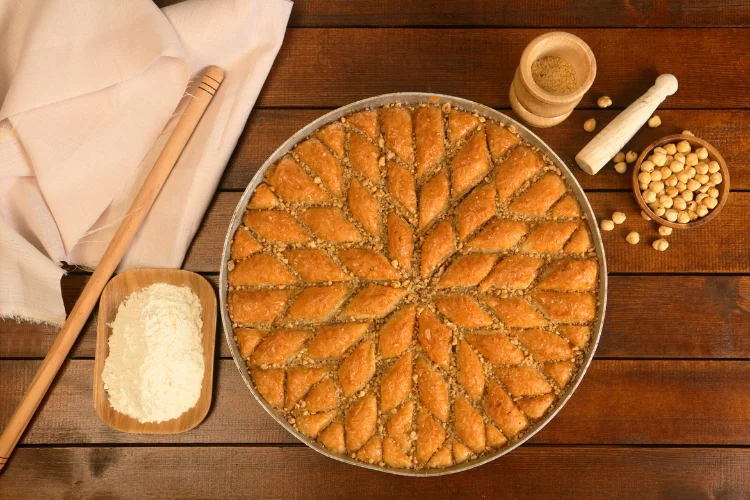
Gaziantep origin is not just a premium retail talking point. It is a quality argument that is relevant to wholesale baklava buyers across all three segments — retail, foodservice, and private label — because it reflects real advantages in ingredient quality and production expertise that no other location can replicate.
The Antep pistachio is the most visible expression of the Gaziantep advantage. Grown in the agricultural region around Gaziantep, the Antep pistachio is smaller, more intensely flavoured, and more vibrantly green than the Iranian or Californian varieties that producers outside the region typically use. A wholesale baklava producer based in Gaziantep sources Antep pistachios directly, at optimal freshness, from a local supply ecosystem that has been developed over generations. The product that results is measurably different — in flavour, in colour, in eating quality — from wholesale baklava made with substitute pistachio varieties.
The production expertise concentrated in Gaziantep is the second dimension of the origin argument. The technical knowledge embedded in the city’s baklava production culture — filo rolling, layering technique, syrup formulation, the precise calibration of butter application — cannot be acquired by establishing a production line elsewhere and replicating the physical process. It is institutional knowledge that lives in the workforce, the supplier relationships, and the production culture of a city that has been making baklava commercially for centuries.
The third dimension is official recognition. Gaziantep baklava holds Protected Geographical Indication status, and the city holds UNESCO Creative City of Gastronomy status. For retail buyers, this recognition supports premium positioning and provides a provenance narrative that premium category buyers and food media respond to. For foodservice buyers, it gives sales teams something credible to say to restaurant and hotel buyers about the product’s credentials. For private label buyers, it is a brand story that can be built into packaging and marketing without overstating anything — the recognition is official and documented.
Frozen and Preservative-Free: The Production Standard That Serves All Three Segments
The decision a wholesale baklava producer makes about shelf life extension — freeze the product or add preservatives — has direct consequences for buyers in all three segments, though the consequences manifest differently in each.
For retail buyers, the clean label advantage of preservative-free wholesale baklava is a positioning asset. No preservatives, no artificial additives, natural ingredients — these claims support premium shelf placement, differentiate product in a crowded dessert category, and align with the growing consumer preference for clean label food across European retail markets.
For foodservice buyers, the quality consistency of frozen wholesale baklava is an operational asset. Every portion thaws to the same standard, regardless of when it was produced or how long it has been in frozen storage. The syrup balance, the filo texture, and the nut filling flavour that characterise well-made Gaziantep baklava are preserved by freezing in a way that preservative-stabilised ambient product cannot match.
For private label buyers, the recipe integrity of preservative-free frozen wholesale baklava is a brand protection asset. A private label brand built on authentic Anatolian baklava credentials cannot afford to have preservatives on the ingredient declaration. Frozen production resolves this without any compromise to shelf life, distribution practicality, or production economics.
The cold chain requirements for wholesale baklava shipped frozen from Gaziantep to European distribution points are standard for the frozen food category: production and storage at -18°C, maintained through transit, with temperature monitoring documentation throughout. The logistics model — frozen container shipment from Turkey to Northern European ports — is well established and operates on reliable schedules.
Certifications and Compliance Across Segments
The certification requirements for a wholesale baklava producer supplying European buyers are broadly consistent across retail, foodservice, and private label, with some segment-specific emphases.
BRCGS, IFS Food, or FSSC 22000 certification is the standard requirement for retail supply — major European supermarket chains require it from their suppliers as a trading condition, and wholesale baklava producers who do not hold current certification in one of these frameworks are not eligible to supply most mainstream retail accounts. HACCP compliance is a legal baseline for all food manufacturers, not a differentiator. Buyers should request current certificates and verify that the scope covers the specific product lines they are sourcing.
Halal certification is a requirement across all three segments for buyers whose customer base includes Muslim consumers — which, in the context of wholesale baklava across European markets, is a commercially significant proportion of the total. The halal certificate scope must cover the full ingredient list of all product lines, not just the protein inputs, and must apply to every SKU a buyer is sourcing. A wholesale baklava producer holding halal certification only for their flagship pistachio SKU is not a compliant halal supplier for a buyer who also sources walnut baklava, kadaifi, or künefe from the same producer.
EU import compliance for frozen wholesale baklava shipped from Turkey involves standard food import documentation that a producer with established European distribution will have standardised. Buyers new to direct sourcing from Turkish producers should discuss the documentation requirements with their prospective supplier before placing their first order, and confirm that the producer’s export team is experienced in handling the compliance requirements of their specific destination markets.
What One Producer Covering All Three Segments Looks Like in Practice
The operational case for consolidating wholesale baklava sourcing under a single producer — rather than maintaining separate supplier relationships for retail, foodservice, and private label requirements — is built on the same logic that drives any consolidated sourcing decision, compounded by the specific characteristics of the baklava category.
One relationship means one quality management process. A buyer managing wholesale baklava supply across retail, foodservice, and private label segments through a single producer has a single point of accountability for quality — one certification file to maintain, one audit trail to manage, one escalation point when issues arise. The administrative overhead of managing three separate wholesale baklava supplier relationships, each with their own certification documentation, delivery schedules, and quality management contacts, is eliminated.
One logistics arrangement means one cold chain to manage. Consolidated wholesale baklava ordering across multiple segments and formats — retail SKUs, foodservice trays, private label lines — in a single shipment optimises the logistics economics and simplifies the receiving and stock management processes at the buyer’s distribution point.
The commercial leverage of consolidated volume is the third advantage. A buyer whose total wholesale baklava volume across retail, foodservice, and private label is consolidated with a single producer has significantly more pricing leverage than a buyer whose volume is split across three separate supplier relationships. Combined volume may trigger pricing tiers that no individual segment’s volume would achieve independently.
The qualification test for a wholesale baklava producer claiming genuine multi-segment capability is track record in all three. Retail supply references, foodservice clients, and an operational private label programme at scale — not theoretical capability, not plans to develop capability, but current, verifiable delivery across all three segments simultaneously.
Why Lezza Foods
Lezza Foods has been producing wholesale baklava since 2013, with production based in Gaziantep. The business today supplies wholesale baklava to retail and foodservice clients across more than 20 European countries and manages private label production for more than 20 brands — which means genuine, current, verifiable delivery across all three buyer segments that this guide has covered.
The retail supply operation covers the full range requirements of mainstream and specialty retail: pistachio baklava, walnut baklava, cashew baklava, kadaifi, künefe, bird’s nest formats, rolled baklava, and assorted gift configurations, all produced to consistent recipe specifications with shelf-ready packaging and multi-market labelling capability. The foodservice supply operation covers full tray formats, portion-cut product, and the frozen convenience that professional kitchen environments require. The private label programme is operational at scale, currently running for more than 20 brands with custom packaging, multi-market labelling compliance, and production scheduling discipline built in as standard.
The production standard is preservative-free and frozen throughout. Antep pistachios, real butter, authentic Anatolian recipes — no additives, no shortcuts. Product ships frozen from Gaziantep to European distribution points via documented cold chain logistics, and arrives at the quality standard that Gaziantep production delivers.
For buyers evaluating Lezza Foods as their wholesale baklava partner across one, two, or all three segments, the product catalogue is available at lezzafoods.eu. The team is set up to handle wholesale, foodservice, and private label enquiries from buyers across Europe.
Conclusion
Wholesale baklava is not one sourcing problem — it is three, each with its own requirements, its own qualification criteria, and its own commercial logic. Retail buyers need volume consistency, packaging compliance, and range depth. Foodservice buyers need portion consistency, frozen convenience, and format flexibility. Private label buyers need recipe control, packaging management, and production discipline.
The wholesale baklava producer who can serve all three segments from a single production base — with Gaziantep origin, preservative-free frozen quality, full-range capability, and the certifications that European buyers require — is the producer worth building a long-term relationship with. That relationship simplifies supply chain management, consolidates commercial leverage, and provides the quality foundation that a growing baklava category in European retail and foodservice demands.