How to Find a Reliable Baklava Wholesale Supplier in Europe
Most European foodservice buyers and retailers who add baklava to their range do so because the demand signal is already there. A distributor supplying Middle Eastern restaurants notices that dessert enquiries keep coming back to the same product. A supermarket buyer watches a competitor’s baklava line sell through consistently and decides it is time to act. A private label brand identifies a gap in the premium pastry category and starts looking for a baklava wholesale supplier in Europe who can fill it.
The demand side of the equation is not in question. Baklava has moved steadily from specialty ethnic retail into mainstream European food channels over the past decade, and that shift shows no sign of reversing. What is in question — and where B2B buyers consistently run into problems — is the supply side. Finding a baklava wholesale supplier in Europe who can deliver consistent quality at scale, with the certifications and operational reliability that professional buyers require, is harder than it looks. The category has attracted a wide range of suppliers at very different levels of capability, and the consequences of choosing the wrong one become visible quickly.
This guide is written for B2B buyers who are evaluating baklava wholesale supplier in Europe, whether for the first time or after a previous supplier relationship that did not work out. It covers the product fundamentals, the qualification criteria that matter, the mistakes that experienced buyers still make, and what a long-term wholesale partnership in this category actually requires.
The European Market for Baklava: What B2B Buyers Need to Understand
Baklava has been present in European specialty food retail for decades, but its commercial profile has changed significantly. Ten years ago, a baklava wholesale supplier in Europe was primarily serving Turkish, Lebanese, and Middle Eastern grocery stores and a handful of specialist importers. Today the buyer landscape looks entirely different. Major supermarket chains across Germany, the Netherlands, Belgium, France, and the UK have added baklava to their permanent range. Hotel and catering groups include it on buffet menus as a standard offering rather than a seasonal curiosity. Food halls and premium grocery concepts stock it alongside French patisserie and Belgian chocolate.
Three structural trends are driving this shift. The first is demographic. Europe’s multicultural consumer base — with significant populations rooted in Turkey, Lebanon, Syria, Egypt, and Morocco — represents a large and loyal market for authentic baklava that has historically been underserved by mainstream retail. These consumers are not buying baklava occasionally. They are buying it regularly, and they notice immediately when the product on the shelf does not meet the quality standard they grew up with. A baklava wholesale supplier in Europe who can deliver genuine authenticity at consistent quality is serving a consumer segment with real repeat purchase behaviour.
The second trend is the broader mainstreaming of Mediterranean and Middle Eastern cuisine among European consumers generally. Hummus, halloumi, and shakshuka have all completed the journey from specialty to mainstream in European retail over the past decade. Baklava is on the same trajectory, and the commercial infrastructure — distribution networks, retail category space, consumer awareness — is already in place to support its continued growth.
The third driver is the premiumisation of the European dessert category. Baklava, properly produced with high-quality pistachios, real butter, and carefully made filo, is a genuinely premium product that commands margins conventional pastry cannot match. For retailers and distributors building a premium dessert offer, finding the right baklava wholesale supplier in Europe is a category investment with a meaningful commercial return — not a line-filling exercise.
What Baklava Is — and Why Production Quality Is Difficult to Fake at Scale
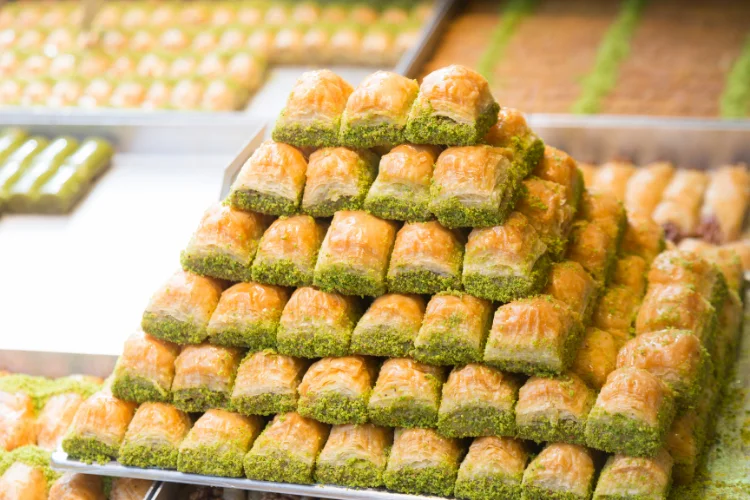
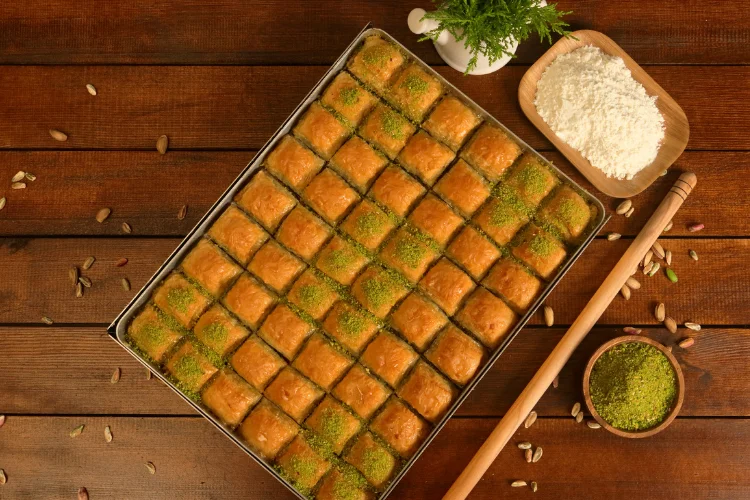
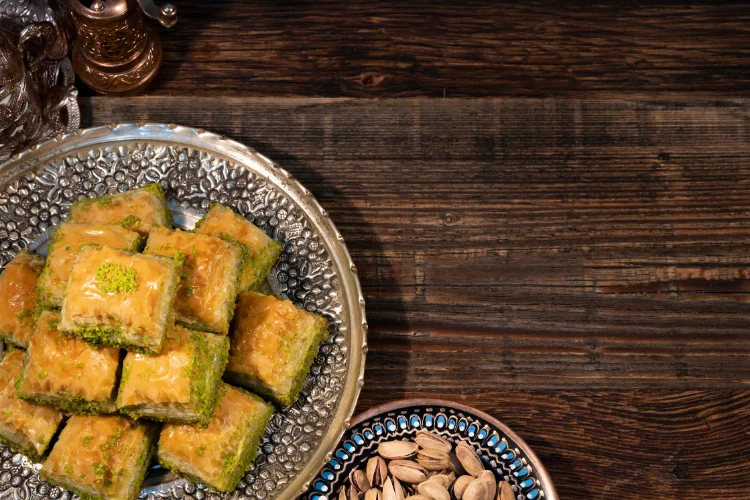
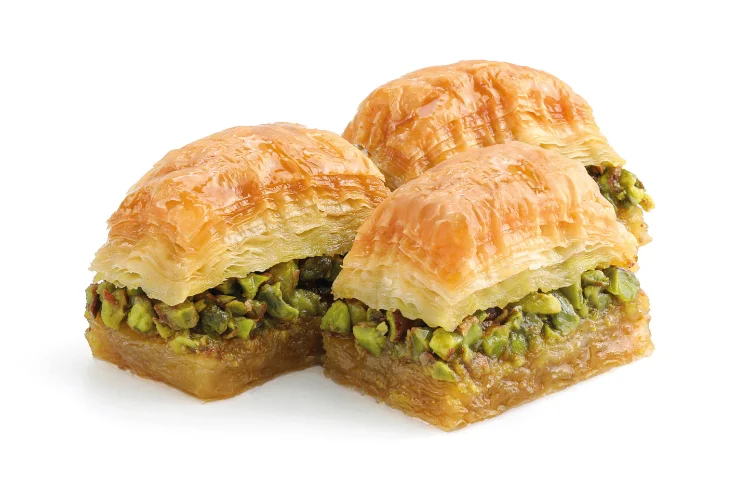
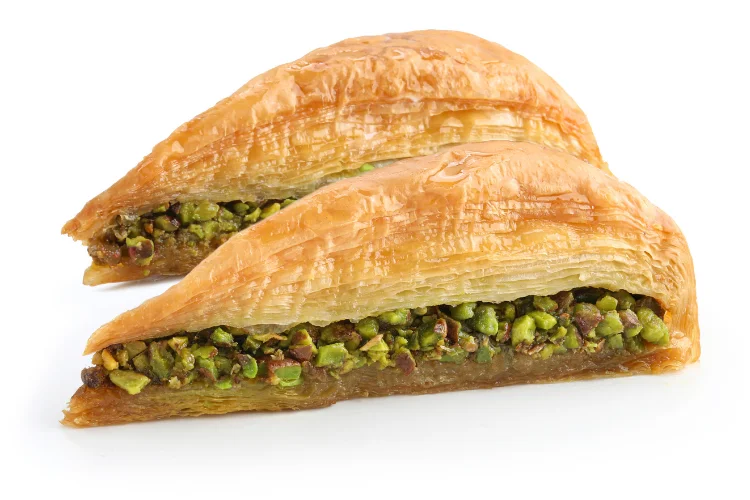
Baklava is a layered pastry dessert built from filo dough, a nut filling — most commonly pistachio or walnut — and a sugar or honey-based syrup. In its traditional Anatolian and Levantine forms, it is a technically demanding product. The filo must be thin and consistent. The butter must be applied correctly between each layer. The nut content must meet a meaningful threshold — a baklava with an inadequate filling is immediately recognisable to anyone who has eaten the real thing. The syrup must be balanced so that the pastry is moist without becoming soggy, and sweet without overwhelming the flavour of the nuts.
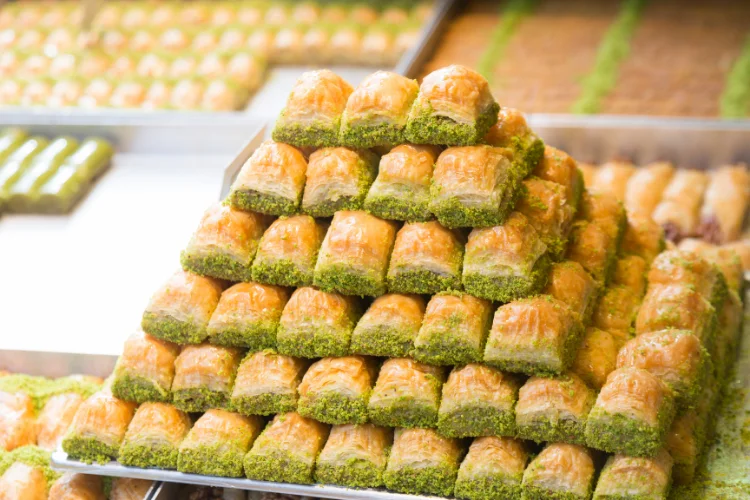
None of this is difficult to achieve in small-batch artisan production. The challenge is maintaining these standards at the volumes required for a baklava wholesale supplier in Europe serving multiple markets simultaneously. Filo consistency becomes harder to control at scale. Butter application must be mechanised without losing the quality that hand production achieves. Nut filling ratios must be enforced across every production run, not just the sample batch that was sent to a prospective buyer. Syrup application must be calibrated so that product delivered to a retailer in the Netherlands has the same eating quality as product delivered to a foodservice operator in Germany three weeks later.
This is why production scale and genuine manufacturing expertise are the first things a B2B buyer should assess in any baklava wholesale supplier in Europe. A supplier who produces excellent baklava in small quantities for local markets is not automatically a supplier who can serve international wholesale clients reliably. The investment in production infrastructure, quality management systems, and recipe control that consistent large-scale baklava production requires is substantial — and not every supplier claiming to operate as a baklava wholesale supplier in Europe has made it.
The Product Range Question: Why Variety Matters in Wholesale Sourcing
Baklava is not a single product. A buyer who approaches the category as if they are sourcing one SKU will quickly discover that their retail or foodservice customers expect variety — and that managing multiple suppliers to deliver that variety creates operational complexity that erodes the commercial case for the category.
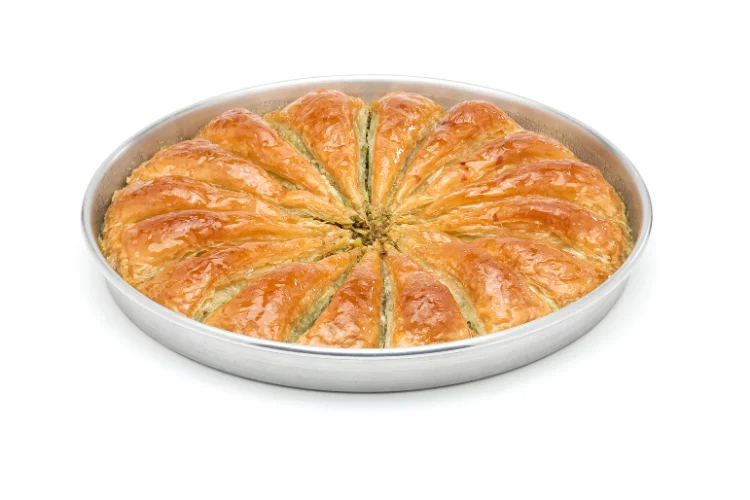
A serious baklava wholesale supplier in Europe should be able to supply the full range of traditional formats: pistachio baklava in its classic rectangular and diamond cuts, walnut baklava, cashew variants, kadaifi — the shredded wheat pastry format that sits alongside classic filo baklava in any authentic Anatolian dessert range — and künefe, the warm cheese pastry that has developed its own following in European foodservice. Beyond these core products, strong suppliers will offer bird’s nest baklava, rolled formats, and assorted gift box configurations that serve the retail gifting segment.
The commercial logic for sourcing this full range from a single baklava wholesale supplier in Europe is the same logic that applies to any consolidated sourcing decision: one supplier relationship, one quality management process, one delivery schedule, one invoice, and one point of contact when something needs to be resolved. For buyers building a Mediterranean dessert category from scratch, or for distributors supplying a customer base that spans both foodservice and retail, this operational simplicity has real value.
It also has implications for how buyers should qualify suppliers. A baklava wholesale supplier in Europe who offers a full range but cannot demonstrate genuine production capability across that range — who lists kadaifi and künefe on their price sheet but whose actual volume and expertise is concentrated in one or two SKUs — is not a genuine full-range partner. Buyers should request samples across the full range they intend to stock, not just the flagship pistachio baklava, before committing to a supply relationship.
Private Label Baklava in Europe: A Growing Segment That Requires the Right Partner
A significant and growing portion of baklava sold in European retail moves under private label — the retailer’s own brand rather than the manufacturer’s. For supermarket chains, discount retailers, and food brands building a Mediterranean or Middle Eastern product range, private label baklava offers margin advantages, brand equity benefits, and the ability to differentiate on packaging and positioning rather than competing on a manufacturer’s brand recognition alone.
Private label baklava production requires a different level of capability than standard wholesale supply. The baklava wholesale supplier in Europe must be able to work to the buyer’s specification rather than their own standard recipes, manage custom packaging across potentially multiple SKUs, handle labelling compliance across different European markets with their varying language and regulatory requirements, and maintain recipe confidentiality where buyers have developed proprietary formulations.
Not every baklava wholesale supplier in Europe have the infrastructure to support serious private label programmes. The operational requirements — dedicated production scheduling, custom packaging management, separate quality documentation for each branded product line — demand manufacturing scale and organisational discipline that smaller suppliers typically cannot sustain alongside their standard wholesale business.
For buyers evaluating a baklava wholesale supplier in Europe for private label capability specifically, the right questions to ask are about track record rather than theoretical capability. How many private label brands does the supplier currently produce for? What markets are those brands sold in? Can the supplier provide examples — without necessarily disclosing client identities — of the packaging and documentation management they handle for existing private label customers? A supplier with genuine private label experience will answer these questions confidently. A supplier who is claiming private label capability they do not actually have will not.
What to Look for When Qualifying a Baklava Wholesale Supplier in Europe
The qualification framework for a baklava wholesale supplier in Europe covers several distinct areas. Each matters independently, and a strong performance in one area does not compensate for a significant weakness in another.
Food Safety Certification
Operating in the European food market as a wholesale supplier requires compliance with recognised food safety management standards. HACCP compliance is the baseline — it is a legal requirement for food businesses operating in the EU, not a differentiating factor. The certifications that distinguish a serious baklava wholesale supplier in Europe from the broader market are BRCGS (British Retail Consortium Global Standards), IFS Food (International Featured Standards), and FSSC 22000. These are the certifications that major European retailers and distributors require from their suppliers, and a baklava wholesale supplier who holds one or more of them has demonstrated that their quality management systems have been audited and verified by an independent third party.
Buyers should ask to see current certificates rather than taking a supplier’s word for their certification status. Certificates have expiry dates, and a supplier whose certification has lapsed — but who continues to reference it in their commercial materials — is presenting a misleading picture of their compliance status.
Ingredient Quality and Sourcing Transparency
The quality of baklava is determined primarily by the quality of three ingredients: the filo pastry, the nuts, and the butter. A baklava wholesale supplier in Europe who uses high-quality Turkish or Iranian pistachios will produce a meaningfully better product than one who substitutes lower-grade nuts to reduce input costs. A supplier who uses real butter rather than vegetable fat alternatives will produce a product with the flavour profile that consumers and foodservice buyers expect from premium baklava.
Ingredient sourcing transparency is a reasonable expectation for any serious wholesale relationship. Buyers should ask where nuts are sourced from, what specification the filo is produced to, and whether the syrup uses sugar, honey, or a combination. Suppliers who cannot or will not answer these questions clearly are suppliers who are likely managing ingredient quality downward in ways that will eventually become visible in the product.
Production Capacity and Scalability
A supplier’s ability to fulfill an initial order does not guarantee their ability to scale as a buyer’s volume grows. This is one of the most common points of failure in wholesale food sourcing relationships — a baklava wholesale supplier in Europe who performs well on a trial order or at initial volumes turns out not to have the production capacity to support a growing account.
Buyers should ask directly about production capacity — total weekly or monthly output, lead times for orders at different volume levels, and how the supplier manages capacity during peak demand periods. For baklava, peak demand in European markets concentrates around Ramadan, Christmas and New Year, and Easter — periods when a supplier without adequate capacity planning will fail to deliver reliably.
Logistics and Delivery Reliability Across Europe
A baklava wholesale supplier in Europe who can produce excellent product but cannot deliver it reliably across the markets a buyer operates in is not a viable long-term partner. Delivery reliability means consistent lead times, temperature-controlled logistics where required, and the ability to supply multiple European markets from a single relationship rather than requiring buyers to manage separate regional supply arrangements.
EU-based production and distribution infrastructure has a practical advantage over third-country sourcing for buyers operating in European markets: no import compliance complexity, no customs delays, and a logistics network that can respond quickly to changes in order volumes or delivery requirements.
Common Mistakes B2B Buyers Make When Sourcing Baklava Wholesale
Even experienced procurement teams make avoidable errors in this category. The following mistakes appear consistently enough that they are worth addressing directly.
Evaluating suppliers on sample quality alone. A baklava sample is produced under conditions — careful preparation, best available ingredients, close quality attention — that may not reflect standard production. The right evaluation approach is to request samples from multiple production batches over time, not a single sample from a supplier who knows they are being evaluated. Buyers who commit to a supply relationship based on a single sample and then discover that delivered product does not match sample quality have made a qualification error that was avoidable.
Negotiating price before establishing specification. Baklava price varies significantly depending on nut content, nut quality, butter specification, and filo quality. A baklava wholesale supplier in Europe offering a lower price per kilogram than their competitors is almost certainly managing one or more of these input quality variables downward. Buyers who negotiate on price before establishing a clear product specification — with agreed nut content percentages, ingredient standards, and quality parameters — will often find that the lower price comes with a product that does not meet their expectations or their customers’ standards.
Not assessing private label capability before it is needed. A buyer who sources standard wholesale baklava from a supplier and then later decides to move to private label may discover that their existing supplier cannot support the transition. Assessing private label capability at the initial qualification stage — even if the buyer has no immediate private label plans — preserves future commercial flexibility without any cost at the qualification stage.
Treating the supplier relationship as transactional. The buyers who get the best outcomes in the baklava category — on quality consistency, on pricing, on responsiveness to issues — are those who invest in the supplier relationship rather than treating it as a commodity transaction. This means regular communication, advance notice of volume changes, and a willingness to work through quality issues constructively rather than immediately switching suppliers at the first problem. Suppliers invest more in accounts that behave like long-term partners.
Ignoring the full product range until a customer asks for it. A buyer who stocks only pistachio baklava because it is the highest-volume SKU will eventually face a customer or a retail buyer who wants walnut, kadaifi, or assorted formats. At that point, they either go back to their existing baklava wholesale supplier in Europe — who may or may not be able to deliver — or they start a new supplier qualification process under time pressure. Qualifying a supplier’s full range capability at the outset, even if only one or two SKUs are ordered initially, avoids this problem entirely.
Why Lezza Foods Is a Trusted Baklava Wholesale Supplier in Europe
Lezza Foods was established in 2013 with production foundations in Turkey, and has been serving the European market since 2018. In that time, it has built a wholesale supply operation covering more than 20 European countries and a private label manufacturing programme serving more than 20 brands. For any B2B buyer looking for a baklava wholesale supplier in Europe, these are not marketing figures — they reflect the operational investment that genuine pan-European wholesale supply in the food category requires.
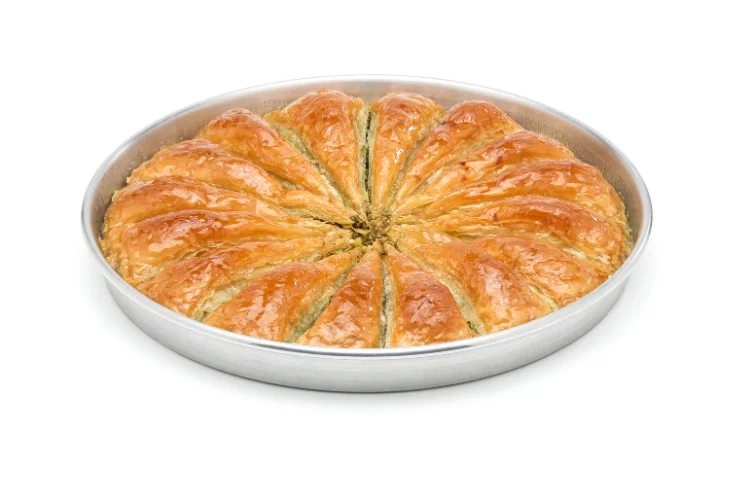
The product range covers the full breadth of traditional Anatolian and Mediterranean desserts: pistachio baklava, walnut baklava, cashew baklava, kadaifi, künefe, bird’s nest formats, rolled baklava, and assorted gift configurations. Each product is produced to recipe specifications that reflect genuine Anatolian production tradition — not simplified Western adaptations designed to reduce input costs. The nut content, the butter specification, and the filo quality are maintained consistently across production runs, not managed downward when input cost pressure increases.
The private label capability is genuine and operational. Lezza Foods currently manages custom packaging, labelling, and branded production for more than 20 brands across European markets. Buyers evaluating Lezza Foods as a baklava wholesale supplier in Europe for private label are not being offered a capability that the business is building — they are being offered access to an operational programme that is already running at scale.
The logistics infrastructure supports reliable delivery across Europe. Operating from EU-based facilities, Lezza Foods can serve retail and wholesale clients across Northern, Western, and Southern Europe without the import compliance complexity and customs lead times that third-country sourcing introduces. For buyers managing frequent replenishment across multiple distribution points, this operational reliability matters as much as product quality.
Beyond baklava, Lezza Foods operates across a broader Mediterranean and Anatolian food range — cakes, börek, lahmacun, pide, kibbeh, mantı, and Maraş-style ice cream — which means buyers looking to consolidate Mediterranean food sourcing under a single supplier relationship have a route to do so. This is particularly relevant for distributors whose customer base spans both sweet and savoury Mediterranean categories, and who currently manage separate supplier relationships for products that a single capable baklava wholesale supplier in Europe could supply.
Building a Long-Term Wholesale Partnership in the Baklava Category
The baklava category in European retail and foodservice is not going to contract. The consumer trends driving its growth — multicultural demographics, Mediterranean cuisine mainstreaming, premium pastry demand — are structural rather than cyclical. Buyers who invest in building strong relationships with the right baklava wholesale supplier in Europe now are positioning themselves ahead of a category that will continue to grow.
What a strong long-term wholesale relationship in this category looks like in practice: a supplier who maintains recipe and quality consistency across every production run, who communicates proactively about any supply constraints before they become delivery failures, who supports private label development when a buyer is ready to move in that direction, and who treats volume growth in a buyer’s business as a shared commercial interest rather than an operational inconvenience.
Finding a baklava wholesale supplier in Europe who meets this standard requires more due diligence than a price comparison and a sample request. It requires the qualification process described in this guide — assessing production capability, verifying certification status, evaluating the full product range, and understanding the private label infrastructure. The investment in that qualification process pays back across every subsequent order in the relationship.
For buyers who are ready to have that conversation, Lezza Foods is worth contacting directly. The product catalogue is available, and the team is set up to handle wholesale and private label enquiries from buyers across Europe.